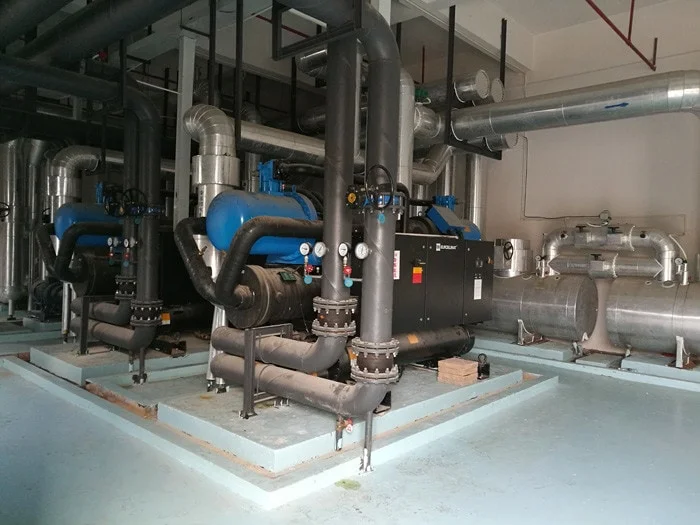
Precision troubleshooting for Carrier 23XRV, Trane RTWD/RTHD, and Bitzer screw chillers stuck at minimum or 100% load.
Direct Engineering Summary
Rotary screw chiller slide valve sticking, causing capacity hunting or fixed load operation, is typically diagnosed by monitoring discharge pressure, suction superheat, and oil pressure differential, alongside linear potentiometer readings. Common causes include varnished oil, failed unloading solenoids, or piston seal bypass. Western Mechanical, Inc.'s UA Local 250 journeymen utilize advanced vibration analysis and refrigerant analysis to pinpoint issues in 70-400 ton units, adhering to ASHRAE 15 and 90.1. Contact us at (661) 251-0111 for CSLB #618138 certified service.
Engineering Tolerances & Governing Standards
Parameter
Specification
Standard
Slide Valve Position Accuracy
Within +/- 1% of full stroke
OEM Specifications, ASHRAE 90.1
Oil Pressure Differential (Lube)
20-30 psid above suction pressure
Compressor Manufacturer Guidelines
Unloading Solenoid Coil Resistance
10-20 Ohms (24VDC), 40-60 Ohms (120VAC)
NEMA MG 1, OEM Data
Refrigerant Oil Acid Level
< 0.10 ppm (acid number)
ASHRAE 15, ARI 700
Vibration Amplitude (Compressor)
< 0.15 in/sec RMS (0-1000 Hz)
ISO 20816-3 (Category III)
Understanding Slide Valve Actuation & Capacity Control
The rotary screw chiller's slide valve is a critical component for capacity modulation, allowing the compressor to match the cooling load by effectively changing the length of the compression stroke. This is typically achieved via hydraulic pressure, controlled by unloading solenoids that direct oil to either side of a piston connected to the slide valve. When these solenoids fail, or the hydraulic system is compromised, the valve can become stuck, leading to either constant minimum load (e.g., 25%) or full load (100%) operation, resulting in significant energy waste and unstable chilled water temperatures.
Modern screw chillers, such as the Carrier 23XRV or Trane RTHD, often employ linear potentiometers to provide precise feedback on the slide valve's actual position to the chiller's control board. Drift or failure of this sensor can mislead the control logic, causing it to misinterpret the slide valve's position and attempt to compensate, leading to erratic capacity hunting. Diagnosing these issues requires a deep understanding of both the hydraulic and electronic control loops, ensuring that the physical valve movement corresponds accurately to the controller's demand.
Diagnosing Sticking: Varnished Oil & Piston Seal Bypass
One of the most insidious causes of slide valve sticking is the accumulation of varnished oil within the compressor's hydraulic system. Over time, refrigerant oil can degrade, especially under high temperatures or with refrigerant contamination, forming sticky residues that coat internal components. This varnish can impede the smooth movement of the slide valve piston, causing it to bind. Western Mechanical, Inc. UA Local 250 journeymen perform comprehensive oil analysis to detect acid content and particulate matter, which are strong indicators of oil degradation and potential varnish formation.
Another common mechanical failure involves the hydraulic piston seals responsible for creating the pressure differential that moves the slide valve. If these seals degrade or fail, oil can bypass the piston, preventing adequate hydraulic force from being applied. This results in the slide valve remaining in a fixed position, often at minimum load due to spring pressure or system design. Our technicians meticulously check oil pressure differentials across the slide valve actuator and inspect for internal oil leaks, ensuring the hydraulic integrity required for precise capacity control.
Advanced Troubleshooting for Unloading Solenoids & Control Logic
The unloading and loading solenoids are the electrical interface to the hydraulic slide valve system. A common diagnostic step involves checking the electrical resistance of these solenoid coils and verifying proper voltage supply from the chiller's control panel. A failed coil (open or shorted) will prevent the solenoid from actuating, directly impacting slide valve movement. However, intermittent issues can be more challenging, requiring observation of solenoid cycling under various load conditions and verification of control board output signals.
Beyond individual component failures, the chiller's control logic itself can contribute to capacity hunting if parameters are miscalibrated or if software glitches occur. Our UA Local 250 technicians utilize OEM diagnostic tools to access and interpret controller alarms, trend data, and setpoints. We analyze refrigerant charge, condenser water temperatures (for water-cooled units), and evaporator approach temperatures, as these external factors can influence the control board's capacity demands and exacerbate underlying slide valve issues in Southern California's dynamic climate.
UA Local 250 Certified Field Diagnostic & Commissioning Protocol
Verify linear potentiometer resistance and output voltage across the full slide valve stroke, comparing to OEM specifications.
Measure current draw and coil resistance of all unloading/loading solenoids; check for proper voltage supply from the controller.
Perform refrigerant oil analysis for acid number, moisture content, and particulate levels to assess varnish risk.
Monitor oil pressure differential across the slide valve actuator during capacity changes to detect piston seal bypass or hydraulic restrictions.
Log chilled water supply/return temperatures and compressor discharge/suction pressures to identify capacity hunting patterns or fixed load operation.
Facility Director & Chief Engineer FAQs
What are the primary indicators of a sticking slide valve?
Primary indicators include erratic chilled water temperatures, the chiller operating constantly at minimum or maximum capacity regardless of load, and persistent capacity hunting where the compressor cycles rapidly. High energy consumption and frequent low-pressure or high-pressure alarms can also signal issues.
Can a refrigerant leak cause slide valve issues?
While not a direct cause of mechanical sticking, a significant refrigerant leak can lead to low suction pressure, causing the chiller to operate at maximum capacity in an attempt to meet the load. This can mask or exacerbate underlying slide valve issues, leading to misdiagnosis if not properly evaluated.
How does varnished oil impact slide valve operation?
Varnished oil creates a sticky film on internal hydraulic components, including the slide valve piston and cylinder walls. This increased friction prevents the piston from moving freely, causing the slide valve to bind or stick at certain positions, hindering precise capacity control and leading to operational inefficiencies.
What preventative maintenance can mitigate slide valve sticking?
Regular refrigerant oil analysis and timely oil changes are crucial. Maintaining proper refrigerant charge and ensuring condenser water cleanliness (for water-cooled units) also prevent high-temperature operation that accelerates oil degradation. Western Mechanical, Inc. recommends annual comprehensive chiller inspections.
Acton Headquarters & 24/7 Southern California Dispatch
Western Mechanical, Inc. • 2210 Soledad Canyon Road, Suite O, Acton, CA 93510 • Primary Phone: (661) 251-0111 • 24/7 Toll-Free: (800) 585-5085 • CSLB #618138 (C-20, C-38, C-4)