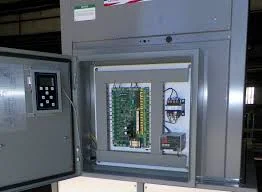
Why overly aggressive gain and fast integral resets wear out Belimo actuators and surge chillers—tuning deadbands, stroke times, and sensor damping properly.
Direct Engineering Summary
Proper PID loop tuning for HVAC valves and VFD fans, as performed by Western Mechanical, Inc. UA Local 250 journeymen, involves optimizing proportional gain, integral reset, and derivative action to prevent hunting and surging. Key parameters include setting appropriate deadbands (typically 0.5-1.0% of span), matching actuator stroke times to process dynamics, and applying sensor damping to mitigate noise. This prevents premature wear on components like Belimo actuators and avoids chiller surges, ensuring stable system operation and energy efficiency. Contact Western Mechanical, Inc. at (661) 251-0111, CSLB #618138.
Engineering Tolerances & Governing Standards
Parameter
Specification
Standard
Chilled Water Valve Deadband
0.5% - 1.0% of full span
ASHRAE Guideline 36-2017
VFD Static Pressure Control Proportional Gain (Kp)
0.5 - 2.0 (dimensionless)
Industry Best Practice
VFD Static Pressure Control Integral Time (Ti)
30 - 120 seconds
Industry Best Practice
Actuator Stroke Time
30 - 90 seconds (for 90% travel)
Manufacturer Specific / Process Dependent
Sensor Damping Filter Time Constant
5 - 15 seconds
Control System Vendor Guidelines
Understanding PID Control Dynamics in HVAC Systems
Proportional-Integral-Derivative (PID) control loops are the backbone of modern HVAC system automation, governing everything from chilled water valve positions to variable frequency drive (VFD) fan speeds. The primary goal is to maintain a setpoint (e.g., supply air temperature, duct static pressure) by adjusting a control output. However, improper tuning of the proportional gain (Kp), integral time (Ti), and derivative time (Td) parameters can lead to oscillatory behavior, commonly known as 'hunting,' which severely compromises system efficiency and component longevity. Overly aggressive Kp can cause overshoot and oscillation, while an integral time that is too fast will exacerbate this by continuously correcting past errors too quickly.
In Southern California's dynamic climate, precise control is paramount for energy efficiency and occupant comfort. A hunting chilled water valve, for instance, will constantly open and close, leading to unstable coil temperatures, reduced chiller efficiency due to fluctuating loads, and premature wear on the valve's Belimo actuator. Similarly, a VFD fan hunting for static pressure will continuously ramp up and down, consuming excess energy, generating noise, and shortening the lifespan of the VFD and fan motor. Western Mechanical, Inc. UA Local 250 journeymen specialize in diagnosing and correcting these control issues, ensuring stable and optimized system performance.
Diagnosing and Mitigating Control Loop Instability
The tell-tale signs of an unstable control loop include sustained oscillations in the controlled variable (e.g., duct static pressure varying by +/- 0.1" w.c. or more), rapid actuator movements, and inconsistent system performance. Often, the root cause is an overly aggressive proportional gain, which causes the controller to overreact to deviations from the setpoint. Coupled with an integral term that resets too quickly, the system can enter a perpetual state of overcorrection. Diagnostic tools like trend logs from the building management system (BMS) are crucial for visualizing these oscillations and identifying the frequency and amplitude of the hunting behavior.
Mitigating instability involves a systematic approach to PID tuning. For chilled water valves, increasing the deadband (e.g., from 0.2% to 0.7% of span) can prevent minor fluctuations from triggering unnecessary actuator movement, thereby reducing wear. Adjusting the actuator's stroke time to be slower (e.g., 60-90 seconds for full travel) can also help dampen oscillations by introducing a lag that matches the process dynamics. For VFD fans controlling static pressure, reducing the proportional gain and increasing the integral time will slow down the controller's response, allowing the system to stabilize without overshooting. Additionally, applying sensor damping can filter out high-frequency noise that might otherwise cause the controller to react to non-existent process changes.
Advanced Tuning Techniques and Lifecycle ROI
Beyond basic Kp and Ti adjustments, advanced tuning techniques like gain scheduling can optimize control performance across varying load conditions. For example, a chiller plant might require different PID parameters during peak cooling demand versus low-load conditions. Implementing feedforward control can also significantly improve stability by anticipating load changes (e.g., linking supply air temperature setpoint to outdoor air temperature) rather than waiting for deviations to occur. These sophisticated strategies require a deep understanding of thermodynamics and control theory, which our UA Local 250 technicians possess.
The return on investment (ROI) for proper PID loop tuning is substantial. By eliminating hunting, facilities can expect significant energy savings due to reduced fan and pump motor cycling, extended lifespan of expensive components like Belimo actuators, VFDs, and chillers, and improved occupant comfort through stable temperature and airflow. For HCAI facilities, stable control loops are critical for maintaining environmental conditions mandated by Title 24 Part 6 and OSHPD. Western Mechanical, Inc. provides comprehensive tuning services, leveraging CSLB #618138 expertise to ensure your mechanical systems operate at peak efficiency and reliability, minimizing operational costs and maximizing equipment longevity.
UA Local 250 Certified Field Diagnostic & Commissioning Protocol
Verify chilled water valve actuator stroke time matches process lag, typically 60-90 seconds for full travel.
Trend BMS data for controlled variable (e.g., SA temp, duct static) and control output (e.g., valve position, VFD speed) to identify oscillation frequency and amplitude.
Adjust proportional gain (Kp) incrementally downwards until oscillations are dampened, then increase slightly for optimal response.
Increase integral time (Ti) to slow down reset action and prevent overcorrection; confirm no steady-state offset remains.
Implement sensor damping (e.g., 5-15 second filter) on noisy inputs like static pressure to prevent controller reacting to signal noise.
Facility Director & Chief Engineer FAQs
What causes chilled water valves to 'hunt'?
Chilled water valves hunt primarily due to overly aggressive proportional gain (Kp) or an integral time (Ti) that is too fast. This causes the controller to overreact to minor temperature deviations, leading to continuous opening and closing of the valve and premature actuator wear.
How does VFD fan hunting impact energy consumption?
VFD fan hunting significantly increases energy consumption. Constant ramping up and down of the motor consumes more power than stable operation. It also places undue stress on the VFD and motor, shortening their operational lifespan and increasing maintenance costs.
What is the role of deadband in preventing valve hunting?
Deadband is a range around the setpoint within which the control output does not change. By setting an appropriate deadband (e.g., 0.5-1.0% of span), minor fluctuations in the controlled variable do not trigger actuator movement, reducing hunting and extending actuator life.
Can sensor noise affect PID loop stability?
Yes, sensor noise can severely affect PID loop stability. If a controller reacts to noisy sensor readings as actual process changes, it will continuously adjust the output, leading to hunting. Applying sensor damping filters can mitigate this by smoothing out the input signal.
Acton Headquarters & 24/7 Southern California Dispatch
Western Mechanical, Inc. • 2210 Soledad Canyon Road, Suite O, Acton, CA 93510 • Primary Phone: (661) 251-0111 • 24/7 Toll-Free: (800) 585-5085 • CSLB #618138 (C-20, C-38, C-4)