WESTERN MECHANICAL, INC. | Primary Dispatch: (661) 251-0111 | 24/7 Hotline: (800) 585-5085 | CSLB #618138 (C-20, C-38, C-4) | 100% UA Local 250 Union
High-Rise Water-Source Heat Pump (WSHP) Loop & Fluid Cooler Service
Optimizing Hydronic Systems for Multi-Story Commercial & Institutional Facilities
Direct Engineering Summary
Western Mechanical, Inc. provides high-rise WSHP loop and fluid cooler service, ensuring optimal performance for closed-circuit evaporative fluid coolers, rooftop boiler injection loops (operating between 65°F and 88°F), riser isolation valves, and tenant WSHP coaxial heat exchangers. Our UA Local 250 journeymen maintain critical components like automatic y-strainer blowdowns to prevent fouling and ensure system integrity, adhering to ASHRAE 90.1 standards. Contact Western Mechanical, Inc. at (661) 251-0111 (CSLB #618138) for expert hydronic system maintenance.
Precision Maintenance for Closed-Circuit Evaporative Fluid Coolers
The closed-circuit evaporative fluid cooler is the critical heat rejection component for high-rise WSHP loops, especially in Southern California's varied climate. Unlike open cooling towers, these units contain the process fluid within a coil, minimizing contamination and reducing water treatment complexity. However, their evaporative nature still necessitates meticulous maintenance of spray pumps, fan motors, fill media, and drift eliminators to ensure optimal heat transfer efficiency. Fouling on the exterior of the coil, often from airborne particulates or scale buildup from the spray water, can significantly degrade performance, leading to elevated loop temperatures and increased WSHP energy consumption.
Western Mechanical, Inc. employs UA Local 250 journeymen to perform comprehensive inspections, including eddy current testing on heat exchanger coils and vibration analysis (ISO 20816-3) on fan and pump assemblies. We meticulously balance spray water distribution and verify proper basin heater operation to prevent freezing in cooler months, a crucial consideration for rooftop installations. Our service protocols also include monitoring bleed-off rates and chemical treatment regimens to control scale and biological growth in the spray water system, ensuring the fluid cooler consistently achieves its design approach temperature to the ambient wet-bulb.
Optimizing WSHP Loop Temperature Control and Boiler Injection
Maintaining the WSHP loop temperature within the optimal range (typically 65°F-85°F for cooling and 70°F-88°F for heating) is paramount for system efficiency and tenant comfort. In high-rise applications, the loop often experiences a net heat gain or loss depending on building occupancy, solar load, and outdoor air conditions. To prevent the loop from dropping below the lower threshold, especially during colder periods, a dedicated rooftop boiler injection loop is employed. This system precisely adds heat to the main WSHP loop, ensuring WSHPs can operate effectively in heating mode without excessive supplemental electric heat.
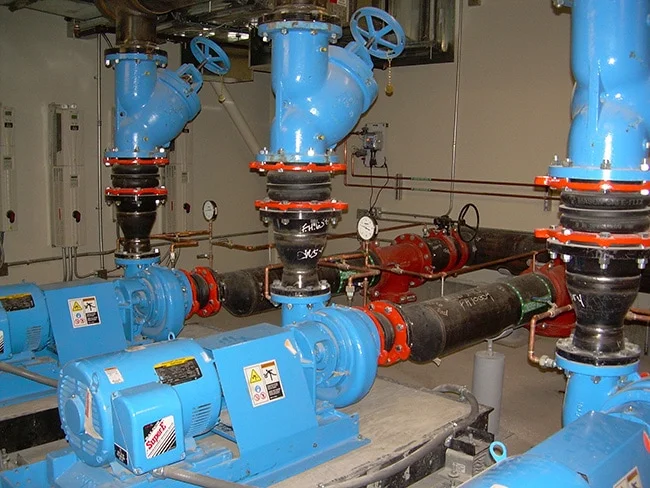
Our expert technicians ensure the boiler injection system, including control valves, pumps, and heat exchangers, operates flawlessly. We calibrate temperature sensors and control logic to prevent overshooting or undershooting the desired setpoint, which can lead to energy waste or tenant discomfort. Furthermore, we inspect and service riser isolation valves and automatic y-strainer blowdowns. The y-strainers are vital for removing particulate matter from the loop, protecting WSHP coaxial heat exchangers from fouling and ensuring unimpeded flow, ultimately extending equipment lifespan and maintaining system efficiency.
Protecting Tenant WSHP Coaxial Heat Exchangers and System Integrity
The coaxial heat exchanger within each tenant's Water-Source Heat Pump is a critical, yet vulnerable, component. Its design, often a tube-in-tube configuration, provides excellent heat transfer but is susceptible to fouling from suspended solids or scale within the WSHP loop. When these heat exchangers become fouled, the WSHP's capacity diminishes, its compressor works harder, and energy consumption rises significantly. This directly impacts tenant comfort and operational costs, making proactive maintenance of the entire loop system essential for sustained performance.
Western Mechanical, Inc. implements a comprehensive strategy to protect these vital components. This includes regular analysis of loop water quality for suspended solids, pH, and corrosion inhibitors. We verify the proper functioning of automatic y-strainers, ensuring their blowdown cycles are correctly timed and effective in removing debris. Furthermore, our UA Local 250 journeymen are proficient in diagnosing flow imbalances and pressure drops across risers, which can indicate blockages or valve issues. By maintaining a clean, balanced, and properly conditioned WSHP loop, we safeguard the longevity and efficiency of every tenant's WSHP unit, ensuring reliable climate control throughout the high-rise facility.
UA Local 250 Certified Field Diagnostic & Commissioning Protocol
Verify WSHP loop differential pressure across risers, ensuring it's within +/- 5% of design using a calibrated manometer.
Inspect fluid cooler spray pump motor amperage and voltage, ensuring readings are within OEM specifications and IEEE 519 harmonic distortion limits.
Test automatic y-strainer blowdown sequence and verify effective debris removal, confirming no residual pressure drop across the strainer.
Measure boiler injection loop supply and return temperatures, confirming proper delta-T (typically 15-20°F) and control valve modulation.
Perform infrared thermography on WSHP coaxial heat exchanger connections to detect localized fouling or flow restrictions, indicating potential performance degradation.
Facility Director & Chief Engineer FAQs
How often should a high-rise WSHP loop's water quality be tested?
WSHP loop water quality, including pH, conductivity, and corrosion inhibitor levels, should be tested monthly. Suspended solids and biological growth should be monitored quarterly. Proactive testing prevents scale, corrosion, and microbial fouling, which can severely degrade heat exchanger performance and system efficiency in high-rise buildings.
What are the common signs of a fouled WSHP coaxial heat exchanger?
Common signs include reduced heating/cooling capacity, increased compressor run time, higher-than-normal refrigerant pressures, and elevated WSHP loop pressure drops. These symptoms indicate inefficient heat transfer due to buildup on the heat exchanger surfaces, requiring immediate attention to restore performance and prevent equipment damage.
Why is a boiler injection loop necessary for a WSHP system?
A boiler injection loop maintains the WSHP system's minimum operating temperature, typically 70°F, during periods of net heat loss from the building. This ensures WSHPs can effectively provide heating without relying on auxiliary electric heaters, which are less efficient, especially in Southern California's cooler winter mornings.
What is the role of automatic y-strainers in a high-rise WSHP loop?
Automatic y-strainers continuously filter particulate matter from the WSHP loop, protecting sensitive components like WSHP coaxial heat exchangers and control valves from fouling and abrasion. Their automated blowdown feature ensures consistent filtration without manual intervention, maintaining optimal flow and system efficiency.
Acton Headquarters & 24/7 Southern California Dispatch
Western Mechanical, Inc. • 2210 Soledad Canyon Road, Suite O, Acton, CA 93510 • Primary Phone: (661) 251-0111 • 24/7 Toll-Free: (800) 585-5085 • CSLB #618138 (C-20, C-38, C-4)