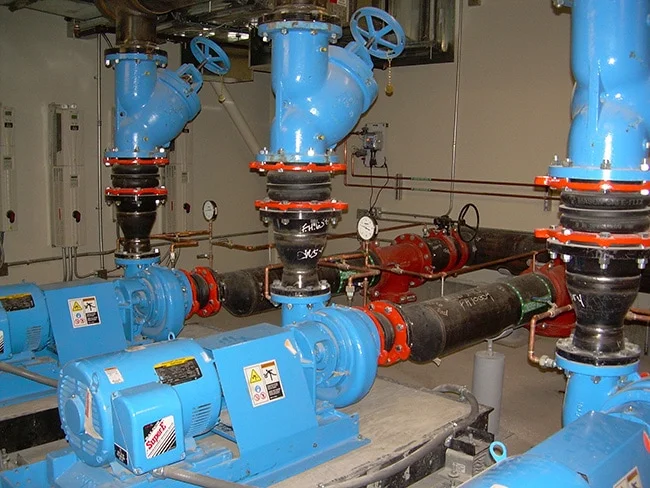
Precision diagnostics and repair for hydronic system integrity and consistent heat delivery in multi-story commercial and industrial facilities.
Direct Engineering Summary
Waterlogged bladder expansion tanks often result from a ruptured EPDM diaphragm, leading to system pressure instability, frequent relief valve weeping, and air-bound top-floor heating coils. Western Mechanical, Inc. diagnoses this by checking the tank's Schrader valve for water and recalculating the nitrogen pre-charge (Static Height in feet ÷ 2.31 + 5 psi). Our UA Local 250 journeymen expertly replace bladders and reset pre-charge to restore system balance, preventing costly damage and ensuring optimal heat transfer. Contact us at (661) 251-0111. CSLB #618138.
Engineering Tolerances & Governing Standards
Parameter
Specification
Standard
Minimum System Pressure Differential (Top Floor)
4-5 psi above static fill pressure
ASHRAE 90.1, ASME Section IV
Expansion Tank Pre-Charge Calculation
Static Height (ft) ÷ 2.31 + 5 psi
ASME Section IV, IAPMO UPC
EPDM Bladder Material Specification
ASTM D2000 M2BG 710 A14 B13 C12 F17
ASTM D2000
Maximum Allowable Water Content in Air Side
< 0.05% by volume (dew point -40°F)
ISO 8573-1 Class 1.2.1
Relief Valve Set Pressure Tolerance
± 2 psi or 10% of set pressure (whichever is greater)
ASME Section IV, NB-23
Diagnosing Ruptured Expansion Tank Bladders
A common culprit behind erratic hydronic system pressures and persistent relief valve weeping in multi-story facilities is a waterlogged expansion tank, often caused by a ruptured EPDM bladder. When the bladder fails, system water infiltrates the tank's air-side, rendering it ineffective at absorbing thermal expansion. This leads to excessive pressure spikes during heating cycles and drops during cooling, forcing the pressure relief valve to open repeatedly. Our UA Local 250 technicians diagnose this by depressing the Schrader valve; if water, not air, escapes, a bladder rupture is confirmed, necessitating immediate repair to prevent further system instability and potential component damage.
Beyond the obvious water discharge, subtle indicators include chronic air accumulation in top-floor heating coils, requiring frequent manual venting. The loss of a functional expansion tank means dissolved air in the system water is no longer effectively separated and absorbed, migrating to high points. This air binding significantly reduces heat transfer efficiency in critical areas, impacting occupant comfort and increasing energy consumption. Western Mechanical, Inc. employs precise pressure gauges and thermal imaging to pinpoint these issues, ensuring a comprehensive assessment before initiating repairs or tank replacement, adhering strictly to ASME Section IV guidelines.
Calculating & Setting Pre-Charge for Optimal Performance
Correct expansion tank pre-charge is paramount for stable hydronic system operation, especially in tall buildings where static head pressure varies significantly. The pre-charge pressure, typically nitrogen, must be precisely calculated to equal the static fill pressure at the highest point of the system plus a minimum operational differential of 5 psi. The formula: Static Height (in feet) ÷ 2.31 (psi/ft) + 5 psi. For instance, a 100-foot tall building requires a pre-charge of approximately 48.2 psi. An incorrectly charged tank, whether too high or too low, will either fail to absorb expansion or allow the system to become air-bound, leading to inefficient heat distribution and premature component wear.
Western Mechanical, Inc.'s certified journeymen meticulously calculate and set the pre-charge using calibrated digital gauges, ensuring the tank effectively manages thermal expansion within the system's design parameters. This critical step prevents relief valve weeping, minimizes energy waste from circulating air-bound coils, and extends the lifespan of boilers, pumps, and piping. Adherence to ASHRAE 90.1 and ASME Section IV standards for pressure vessel integrity and system design is fundamental to our approach, guaranteeing reliable and efficient hydronic system performance across your entire facility in Southern California.
Preventing Relief Valve Weeping & Air Binding
Frequent relief valve weeping is not merely an annoyance; it signals a fundamental imbalance in the hydronic system, often directly attributable to an improperly functioning expansion tank. Each weep event not only wastes treated water but also introduces fresh, oxygen-rich makeup water, accelerating internal corrosion within boilers, pipes, and coils. By ensuring the expansion tank's bladder is intact and its pre-charge is accurately set to accommodate the entire system's thermal expansion, we eliminate the root cause of these pressure excursions, thereby preventing costly water loss and component degradation.
Beyond the expansion tank, air binding in top-floor heating coils can be mitigated through proper air elimination strategies, including strategically placed air vents and a correctly sized and charged expansion tank. Our UA Local 250 technicians employ advanced techniques like ultrasonic leak detection for pinpointing air ingress points and utilize high-capacity air separators to continuously remove dissolved gases. This holistic approach, combined with precise pre-charge management, guarantees consistent heat delivery, reduces pump cavitation, and significantly extends the operational life of your entire hydronic heating system, optimizing lifecycle ROI for your commercial or industrial property.
UA Local 250 Certified Field Diagnostic & Commissioning Protocol
Verify expansion tank inlet valve is open and not obstructed.
Depress Schrader valve on expansion tank; confirm only air (or nitrogen) escapes, not water.
Isolate expansion tank, drain system pressure, and measure current pre-charge with a calibrated digital gauge.
Calculate required pre-charge: Static Height (ft) ÷ 2.31 + 5 psi, then adjust tank to calculated pressure using dry nitrogen.
Monitor top-floor heating coil temperatures and pressure differential for air-binding symptoms post-service.
Facility Director & Chief Engineer FAQs
How does a waterlogged expansion tank affect my hydronic system?
A waterlogged tank loses its ability to absorb thermal expansion, leading to erratic system pressures, frequent relief valve weeping, and chronic air accumulation in high points like top-floor coils, reducing heating efficiency and potentially damaging components. Western Mechanical, Inc. diagnoses and repairs these issues.
What is the correct pre-charge pressure for an expansion tank?
The correct pre-charge equals the static fill pressure at the highest point of the system plus a 5 psi operating differential. It's calculated as Static Height (ft) ÷ 2.31 + 5 psi. Our UA Local 250 experts ensure precise calibration.
Why do my top-floor heating coils keep getting air-bound?
Air-bound coils often indicate a compromised expansion tank or inadequate air elimination. A ruptured bladder allows air to enter the system, migrating to high points. Correcting the expansion tank's function and installing proper air vents are key solutions from Western Mechanical, Inc.
Can Western Mechanical, Inc. replace expansion tank bladders?
Yes, Western Mechanical, Inc. specializes in replacing ruptured EPDM bladders in commercial and industrial hydronic expansion tanks. Our CSLB #618138 certified UA Local 250 journeymen ensure proper installation and pre-charge, restoring system integrity and preventing future issues.
Acton Headquarters & 24/7 Southern California Dispatch
Western Mechanical, Inc. • 2210 Soledad Canyon Road, Suite O, Acton, CA 93510 • Primary Phone: (661) 251-0111 • 24/7 Toll-Free: (800) 585-5085 • CSLB #618138 (C-20, C-38, C-4)