WESTERN MECHANICAL, INC. | Primary Dispatch: (661) 251-0111 | 24/7 Hotline: (800) 585-5085 | CSLB #618138 (C-20, C-38, C-4) | 100% UA Local 250 Union
Diagnosing & Correcting Motor Soft Foot Before Laser Shaft Alignment
Precision millwright services to eliminate stator distortion caused by warped motor feet and improper shimming, ensuring optimal rotating equipment performance.
Direct Engineering Summary
Motor soft foot, where one or more motor feet do not sit flush on the baseplate, causes stator distortion and compromises shaft alignment. A differential gap exceeding 0.002 inches (0.05 mm) between the motor foot and baseplate indicates soft foot. Western Mechanical, Inc. corrects this using precision stainless steel shims, typically 0.001 to 0.005 inches thick, followed by laser alignment, ensuring the stator air-gap is concentric and preventing premature bearing failure. Our UA Local 250 journeymen utilize this technique, adhering to ISO 20816-3, CSLB #618138. Call (661) 251-0111.
Engineering Tolerances & Governing Standards
Parameter
Specification
Standard
Maximum Soft Foot Differential
0.002 inches (0.05 mm)
ISO 20816-3
Stator Air Gap Concentricity
Within 5% of nominal
IEEE 112-2017
Shim Material
304 Stainless Steel
ASTM A240
Shim Thickness Increment
0.001 inches (0.025 mm)
Manufacturer Specific
Bolt Torque Variation (Post-Soft Foot Correction)
Within 5% of specified value
ASME PCC-1
The Physics of Soft Foot & Stator Distortion
Motor soft foot occurs when the mounting feet of an electric motor do not sit coplanar on the baseplate, creating a gap under one or more feet. When hold-down bolts are tightened, this uneven support introduces mechanical stress into the motor casing, distorting the stator housing. A differential gap as small as 0.004 inches can significantly warp the stator, causing the rotor to operate with a non-concentric air gap. This uneven air gap leads to unbalanced magnetic forces, increased vibration, elevated bearing temperatures, and ultimately, premature motor failure.
The impact of soft foot extends beyond just vibration. The distorted stator creates an elliptical air gap, which can induce circulating currents in the rotor, reducing motor efficiency and increasing power consumption. In Southern California's industrial environments, where energy costs are a critical concern, even minor inefficiencies accumulate rapidly. Our UA Local 250 millwrights understand that correcting soft foot is not merely an alignment prerequisite but a fundamental step in preserving motor integrity, maximizing operational lifespan, and optimizing energy expenditure.
Precision Diagnostics: Feeler Gauges to Laser Alignment
Diagnosing soft foot begins with a systematic approach. Initial checks involve using a precision feeler gauge to measure the gap under each motor foot while the hold-down bolts are snug, but not fully torqued. A true soft foot condition is identified when a gap greater than 0.002 inches (0.05 mm) is consistently observed under one or more feet. This initial mechanical assessment is crucial before any laser shaft alignment attempts, as attempting to align a motor with uncorrected soft foot is futile; the alignment will shift the moment the bolts are fully torqued.
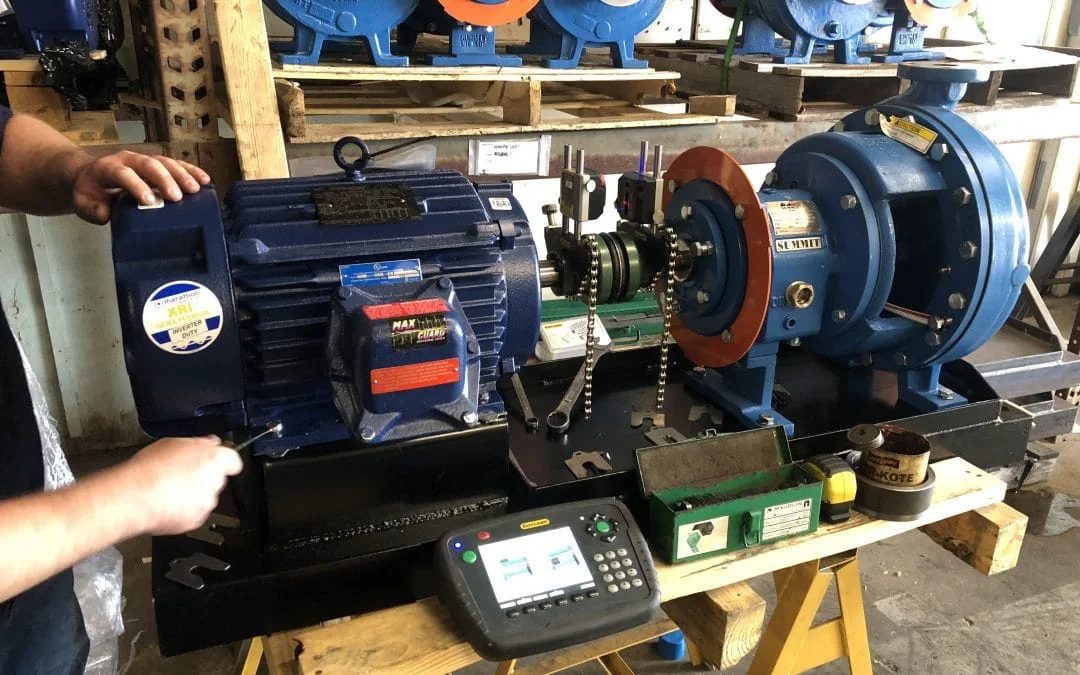
Once identified, Western Mechanical, Inc. employs a structured four-step correction process. First, the motor is unbolted, and the largest gap is measured. Second, precision-cut stainless steel shims, typically ranging from 0.001 to 0.005 inches in thickness, are inserted to fill the gap, ensuring full contact. Third, the bolts are lightly snugged, and the feeler gauge test is repeated to confirm coplanarity across all feet. Finally, with soft foot eliminated, our UA Local 250 journeymen proceed with high-precision laser shaft alignment, achieving coupling tolerances far beyond conventional methods, ensuring compliance with ISO 20816-3 vibration standards.
Long-Term Reliability & ROI for Industrial Facilities
Eliminating motor soft foot is a critical investment in the long-term reliability and operational efficiency of industrial rotating equipment. Uncorrected soft foot can reduce bearing life by up to 50%, increase power consumption by 2-5%, and lead to unscheduled downtime dueining critical production cycles. For facilities in Los Angeles and Ventura counties, where continuous operation is paramount, preventing these failures translates directly into substantial cost savings and improved productivity. Our precision millwright services ensure your critical assets perform optimally.
Western Mechanical, Inc.'s commitment to precision extends to the lifecycle cost of your machinery. By meticulously correcting soft foot and performing accurate laser alignment, we mitigate the root causes of many common motor and pump failures. This proactive approach minimizes maintenance interventions, extends equipment lifespan, and enhances overall plant reliability. Our CSLB #618138 certified UA Local 250 union journeymen deliver unparalleled expertise, ensuring that your mechanical systems operate with maximum efficiency and minimal risk of costly breakdowns.
UA Local 250 Certified Field Diagnostic & Commissioning Protocol
Perform initial feeler gauge check under each motor foot with bolts snug (not torqued) to identify gaps > 0.002 inches.
Identify 'true' soft foot by loosening all bolts, then tightening one bolt fully and checking gaps under other three feet; repeat for each foot.
Insert precision stainless steel shims (0.001-0.005 inch increments) to fill identified gaps, ensuring full contact.
Re-snug all hold-down bolts and re-verify coplanarity with feeler gauge across all feet; adjust shims until all gaps are < 0.001 inch.
Proceed with 4-point laser shaft alignment, verifying final alignment tolerances (e.g., 0.0005 inch offset, 0.0005 inch/inch angularity) after final bolt torque.
Facility Director & Chief Engineer FAQs
Why is soft foot correction more critical than just shaft alignment?
Soft foot distorts the motor's internal components, specifically the stator, causing an uneven air gap. This internal stress leads to premature bearing failure and reduced motor efficiency, issues that shaft alignment alone cannot resolve. Correcting soft foot first ensures the motor itself is mechanically sound before alignment.
What types of shims are best for correcting motor soft foot?
Precision-cut, burr-free stainless steel shims are ideal. They offer excellent corrosion resistance, consistent thickness, and structural integrity, preventing compression or deformation under load. Using multiple thin shims is generally preferred over one thick shim for better load distribution and finer adjustment.
How often should soft foot be checked on critical equipment?
Soft foot should be checked whenever a motor or pump is installed, moved, or undergoes major maintenance. For critical rotating equipment, incorporating a soft foot check into a periodic vibration analysis or precision alignment program (e.g., annually or bi-annually) can proactively prevent issues.
Can soft foot cause electrical issues in a motor?
Yes, indirectly. The stator distortion caused by soft foot leads to an uneven air gap, which creates unbalanced magnetic forces. This can induce circulating currents, increase current draw, and lead to localized hot spots within the stator windings, potentially shortening insulation life and increasing electrical losses.
Acton Headquarters & 24/7 Southern California Dispatch
Western Mechanical, Inc. • 2210 Soledad Canyon Road, Suite O, Acton, CA 93510 • Primary Phone: (661) 251-0111 • 24/7 Toll-Free: (800) 585-5085 • CSLB #618138 (C-20, C-38, C-4)