WESTERN MECHANICAL, INC. | Primary Dispatch: (661) 251-0111 | 24/7 Hotline: (800) 585-5085 | CSLB #618138 (C-20, C-38, C-4) | 100% UA Local 250 Union
Variable-Primary Chilled Water Flow Conversion & PICV Retrofits
Optimizing Hydronic Systems by Eliminating Decoupler Bypass & Low Delta-T Syndrome
Direct Engineering Summary
Variable-primary chilled water flow conversion eliminates the inefficiencies of legacy primary-secondary systems by removing the decoupler bypass and integrating Pressure-Independent Control Valves (PICVs). This retrofit improves chiller plant Delta-T, reduces pumping energy by up to 50%, and enhances overall system stability. Western Mechanical, Inc., CSLB #618138, employs UA Local 250 journeymen to execute these complex hydronic upgrades, ensuring adherence to ASHRAE 90.1 standards and optimal performance for Southern California facilities. Contact us at (661) 251-0111 for expert service.
Engineering Tolerances & Governing Standards
Parameter
Specification
Standard
Chiller Plant Delta-T Improvement
Minimum 3-5°F increase (target 12-15°F)
ASHRAE 90.1-2019
Pumping Energy Reduction
25-50% documented savings
Title 24 Part 6 (2022)
PICV Pressure Independence
Maintains flow within +/- 5% of setpoint
BSR/AHRI Standard 1330P
Decoupler Bypass Flow
Reduced to <5% of design flow
System Design Best Practice
VFD Control Accuracy
Maintains differential pressure within +/- 1 psi
NEMA MG 1, IEEE 519
Understanding Low Delta-T Syndrome and Bypass Flow
The pervasive issue of Low Delta-T syndrome in primary-secondary chilled water systems stems primarily from the constant volume primary loop and the often oversized or poorly controlled bypass line. When three-way control valves on terminal units are used, they continuously bypass chilled water back to the primary loop, artificially raising the return water temperature and forcing chillers to operate at reduced efficiency. This phenomenon significantly diminishes the chiller's effective capacity, leading to higher energy consumption and an inability to meet cooling loads effectively, especially during peak Southern California summer conditions.
Further exacerbating this problem is the 'decoupler bypass syndrome,' where the bypass line between the primary and secondary loops becomes a path of least resistance, allowing a substantial portion of primary flow to short-circuit back to the chillers without passing through the building's load. This results in inadequate flow to the secondary loops and terminal units, necessitating higher pump speeds and further contributing to low Delta-T. Western Mechanical, Inc. addresses these thermodynamic inefficiencies by converting to variable-primary flow, eliminating the bypass, and ensuring all chilled water contributes to useful heat transfer.
The Engineering Solution: Variable-Primary Flow with PICVs
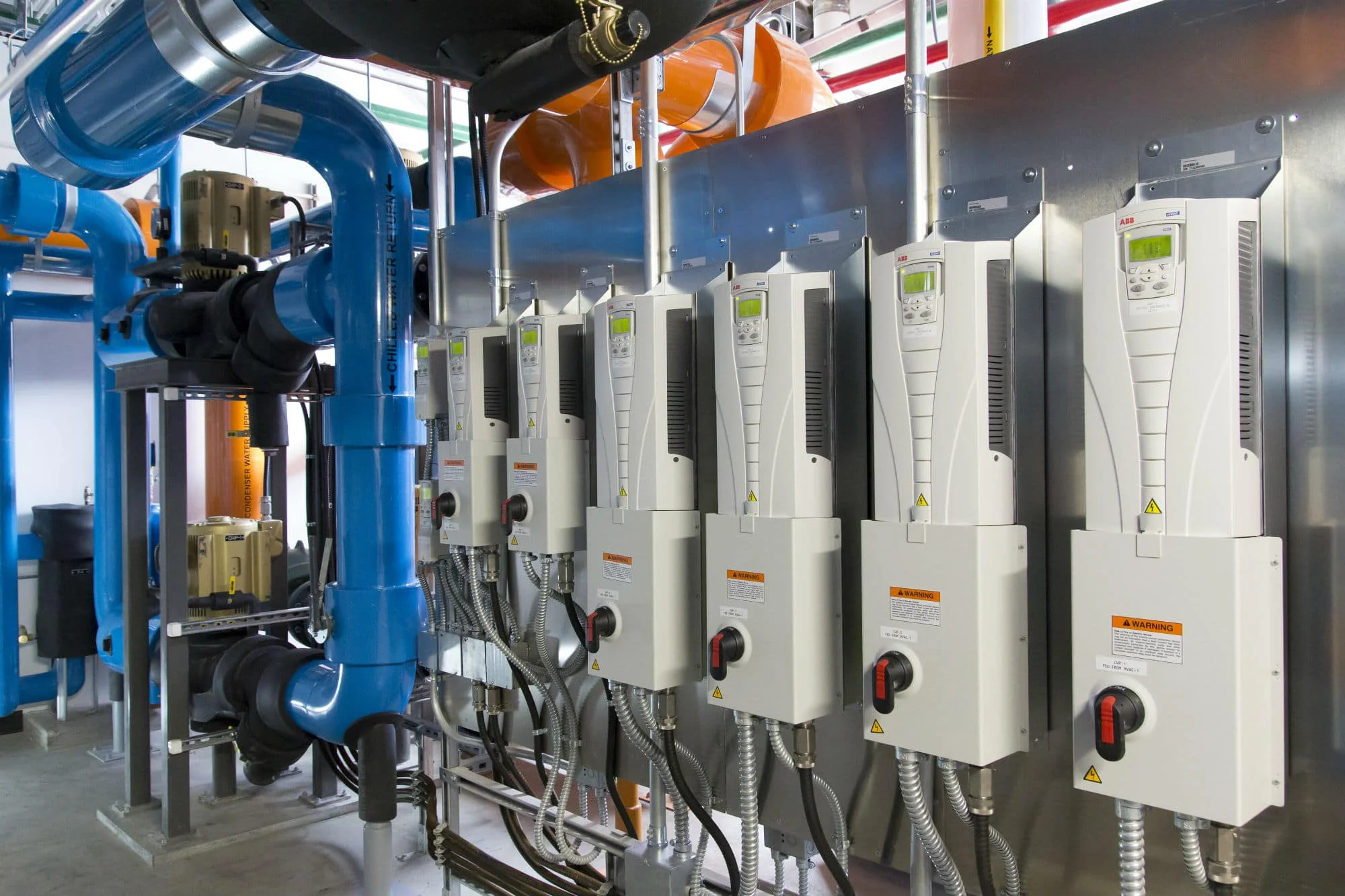
Converting a legacy primary-secondary system to variable-primary flow involves a fundamental redesign of the hydronic distribution. The decoupler bypass is removed or significantly restricted, and the primary pumps are converted to variable speed operation, directly responding to the building's cooling load. This allows the chiller plant to operate with a single, variable-speed pumping system, reducing both capital and operational costs associated with multiple pumps and their controls. The core benefit is that chilled water flow directly correlates with demand, ensuring optimal chiller performance and elevated Delta-T.
Integral to this conversion is the deployment of Pressure-Independent Control Valves (PICVs) at each terminal unit. Unlike traditional two-way or three-way valves, PICVs combine a control valve and a dynamic balancing valve into a single unit, maintaining a constant flow rate regardless of differential pressure fluctuations across the coil. This precise flow control eliminates over-pumping and ensures that each coil receives its design flow, thereby maximizing heat transfer efficiency and preventing the return of high-temperature, low-Delta-T water to the chiller plant. Our UA Local 250 journeymen are experts in PICV selection, sizing, and commissioning.
Lifecycle ROI and Southern California Compliance
The lifecycle return on investment for a variable-primary chilled water flow conversion is substantial, driven primarily by significant energy savings from reduced pumping power and improved chiller efficiency. Facilities often see a 25-50% reduction in pumping energy, coupled with extended chiller lifespan due to more stable operating conditions and fewer starts/stops. Beyond energy, maintenance costs are reduced by simplifying the hydronic system and eliminating components prone to failure in constant-volume setups. These savings quickly offset the initial investment, often within 3-5 years, making it an attractive upgrade for facility directors.
Furthermore, these retrofits align perfectly with Southern California's stringent energy codes and utility incentive programs. Adherence to Title 24 Part 6 and ASHRAE 90.1 standards is enhanced, potentially qualifying projects for significant rebates from local utilities like SCE or SoCalGas. Western Mechanical, Inc. ensures that all conversions are engineered and installed to meet these exacting standards, providing comprehensive documentation for compliance and incentive applications. Our expertise guarantees not only peak operational efficiency but also regulatory peace of mind for your commercial or industrial facility.
UA Local 250 Certified Field Diagnostic & Commissioning Protocol
Verify existing system Delta-T and flow rates using ultrasonic flow meters and calibrated RTD sensors.
Perform a comprehensive hydronic balance validation post-PICV installation, confirming design flow at each terminal unit.
Calibrate VFDs for primary chilled water pumps, establishing differential pressure setpoints and verifying stable operation.
Conduct thermal imaging of chiller evaporator and condenser barrels to confirm uniform temperature distribution and identify fouling.
Log chiller kW/ton performance pre- and post-conversion to quantify energy efficiency improvements and validate ROI.
Facility Director & Chief Engineer FAQs
What is the primary benefit of converting to variable-primary flow?
The primary benefit is a significant improvement in chiller plant Delta-T, leading to higher chiller efficiency, reduced pumping energy, and enhanced overall system stability. This directly translates to lower operational costs and extended equipment lifespan for your facility.
How do Pressure-Independent Control Valves (PICVs) contribute to efficiency?
PICVs ensure that each terminal unit receives its precise design flow rate, regardless of pressure fluctuations in the system. This prevents over-pumping, eliminates bypass flow at the coil, and ensures that all chilled water contributes effectively to heat transfer, maximizing coil and chiller performance.
Will this conversion require new chillers?
Typically, no. The conversion focuses on optimizing the hydronic distribution system and control strategy, allowing existing chillers to operate more efficiently. In fact, improving Delta-T can often unlock previously unavailable capacity from existing chiller assets.
What is the typical payback period for this type of retrofit?
The payback period for a variable-primary chilled water flow conversion often ranges from 3 to 5 years, driven by substantial energy savings from reduced pumping and improved chiller efficiency. Western Mechanical, Inc. can provide detailed ROI analyses for your specific facility.
Acton Headquarters & 24/7 Southern California Dispatch
Western Mechanical, Inc. • 2210 Soledad Canyon Road, Suite O, Acton, CA 93510 • Primary Phone: (661) 251-0111 • 24/7 Toll-Free: (800) 585-5085 • CSLB #618138 (C-20, C-38, C-4)