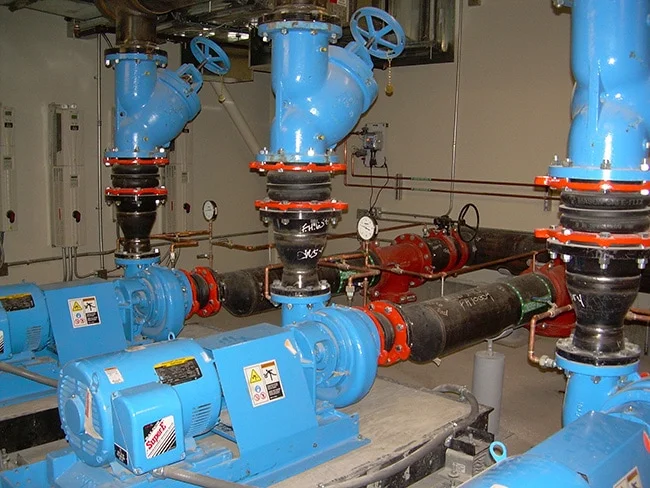
Preventing Condenser Tube Sheet Fouling from Crushed Baskets and Tower Debris Carryover
Direct Engineering Summary
Stopped-up chiller basket strainers, often caused by crushed perforated baskets or cooling tower debris, lead to increased condenser differential pressure and reduced heat transfer efficiency. Western Mechanical, Inc. retrofits existing systems with differential pressure (DP) transmitters and automated blowdown valves, typically actuated when DP exceeds 5-7 PSID, to prevent condenser tube sheet fouling and high-pressure safety cutouts. This proactive maintenance, performed by UA Local 250 journeymen, ensures optimal chiller performance and extends equipment lifespan. Contact CSLB #618138 at (661) 251-0111.
Engineering Tolerances & Governing Standards
Parameter
Specification
Standard
Condenser Water Strainer DP Setpoint (Alarm)
5.0 PSID (34.5 kPa) above clean
ASHRAE 90.1-2019 Appendix G
Condenser Water Strainer DP Setpoint (Blowdown)
7.0 PSID (48.3 kPa) above clean
Manufacturer Specific / Best Practice
Maximum Allowable Strainer Pressure Drop
10.0 PSID (68.9 kPa)
ASME B31.1 Power Piping Code
Blowdown Valve Actuation Time
< 5 seconds (full open/close)
Industrial Control Systems (ICS) Standards
Debris Particle Size Retention
1/8 to 3/16 inch (3.2 to 4.8 mm)
Cooling Tower Institute (CTI) STD-152
The Critical Role of Condenser Water Strainers in Chiller Performance
Condenser water strainers are a vital, yet often overlooked, component in maintaining the thermal efficiency and longevity of centrifugal and screw chillers. Their primary function is to intercept suspended solids, such as cooling tower basin sediment, biological growth, scale, and even fragments of crushed strainer baskets, before they can foul the delicate condenser tube sheets. When these strainers become clogged, the differential pressure across them increases, directly impeding condenser water flow. This flow restriction reduces the heat rejection capacity of the chiller, forcing it to operate at higher condensing temperatures and pressures, ultimately decreasing COP and increasing energy consumption.
The consequences of a neglected, stopped-up strainer extend beyond mere inefficiency. Persistent high differential pressure can lead to a cascade of operational issues, including nuisance high-pressure safety cutouts, especially during peak ambient conditions in Southern California's hot summers. More critically, reduced flow can exacerbate localized corrosion within condenser tubes and contribute to biofouling, necessitating costly chemical cleaning or even premature tube replacement. Western Mechanical, Inc. emphasizes proactive monitoring and automated solutions to mitigate these risks, ensuring reliable chiller operation for critical facilities like hospitals and data centers.
Diagnosing and Mitigating Strainer Fouling with DP Transmitters
Accurate diagnosis of strainer fouling begins with reliable differential pressure (DP) measurement. Retrofitting existing strainer installations with high-precision DP transmitters provides real-time data on the pressure drop across the strainer basket. A gradual increase in DP signals an accumulation of debris, while a sudden spike might indicate a catastrophic event like a crushed basket or a large slug of tower fill. These transmitters integrate seamlessly with Building Management Systems (BMS), allowing facility engineers to trend performance, establish alarm setpoints (typically 5 PSID above clean), and schedule maintenance proactively rather than reactively responding to chiller trips.
Beyond simple alarming, the integration of DP transmitters facilitates predictive maintenance strategies. By analyzing historical DP data, our UA Local 250 journeymen can identify seasonal trends in fouling, optimize blowdown schedules, and even diagnose upstream issues within the cooling tower system, such as failing drift eliminators or basin filter bypasses. This data-driven approach minimizes unscheduled downtime, reduces the labor associated with manual strainer cleaning, and ensures that the chiller plant operates within its design parameters, maximizing both energy efficiency and equipment lifespan in demanding industrial and commercial environments.
Automated Blowdown Valve Retrofits for Enhanced Reliability
The ultimate solution for managing condenser water strainer fouling is the implementation of automated blowdown valve retrofits. When the DP transmitter detects a pressure differential exceeding a predetermined setpoint (e.g., 7 PSID), a signal is sent to a robust, fast-acting motorized or pneumatic ball valve installed on the strainer's blowdown port. This valve automatically opens, rapidly flushing accumulated debris from the strainer basket and discharging it to waste, typically for a timed duration of 10-30 seconds, before resealing. This automated process eliminates the need for manual intervention, which is often neglected due to staffing constraints or safety concerns.
Western Mechanical, Inc.'s CSLB #618138 certified technicians specialize in designing and installing these automated systems, ensuring proper sizing of the blowdown line and valve, and seamless integration with existing control logic. The benefits are substantial: continuous strainer cleaning maintains optimal condenser water flow, preventing tube sheet fouling and significantly reducing the risk of chiller high-pressure trips. This translates into consistent chiller performance, lower operational costs through reduced energy consumption, and extended maintenance intervals, offering a rapid return on investment for any facility relying on robust central plant operations in Southern California.
UA Local 250 Certified Field Diagnostic & Commissioning Protocol
Verify condenser water strainer differential pressure (DP) using calibrated gauges or integral DP transmitter, noting clean baseline.
Inspect strainer basket for signs of crushing, perforation damage, or excessive debris accumulation, documenting material and quantity.
Confirm proper operation and cycle time of automated blowdown valve, verifying full open/close and absence of leaks.
Calibrate and test DP transmitter accuracy against a known pressure source, ensuring output aligns with BMS readings within +/- 0.5 PSID.
Analyze cooling tower water quality reports for suspended solids and biological growth, correlating with strainer fouling rates.
Facility Director & Chief Engineer FAQs
How often should condenser water strainers be inspected?
Manual inspection frequency depends on water quality; however, with a DP transmitter and auto-blowdown, visual inspections can be reduced to quarterly, supplemented by alarm monitoring. Western Mechanical, Inc. recommends a baseline annual physical inspection for structural integrity.
What causes strainer baskets to crush or fail?
Strainer baskets can crush due to excessive differential pressure from severe clogging, or from improper installation/material selection. High flow rates against a partially obstructed basket can also deform weaker materials. Our UA Local 250 experts specify robust basket materials.
Can automated blowdown systems save energy?
Yes, by maintaining optimal condenser water flow and preventing tube sheet fouling, automated blowdown systems ensure chillers operate at their design efficiency. This reduces compressor load and power consumption, leading to significant energy cost savings over time.
Is a permit required for installing an auto-blowdown system?
Permit requirements vary by jurisdiction and system complexity. Generally, modifications to central plant piping and controls may require mechanical and electrical permits. Western Mechanical, Inc. handles all necessary permitting and code compliance for CSLB #618138 projects.
Acton Headquarters & 24/7 Southern California Dispatch
Western Mechanical, Inc. • 2210 Soledad Canyon Road, Suite O, Acton, CA 93510 • Primary Phone: (661) 251-0111 • 24/7 Toll-Free: (800) 585-5085 • CSLB #618138 (C-20, C-38, C-4)