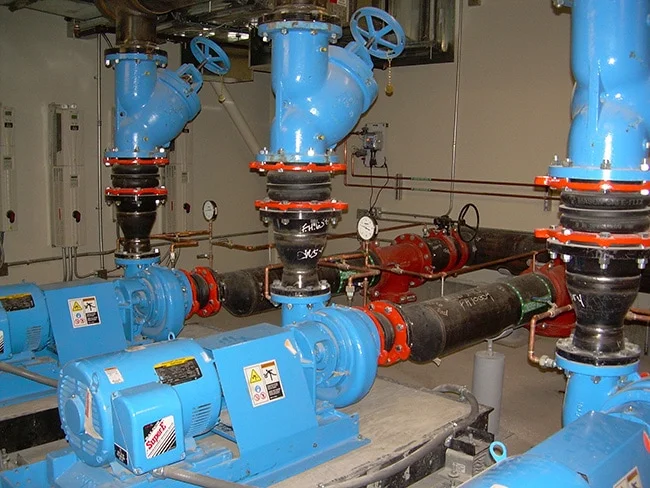
Western Mechanical, Inc. provides comprehensive plate and frame heat exchanger (HX) clean-in-place (CIP) descaling and regasketing services, adhering to stringent standards for Alfa Laval, Mueller, Sondex, and Bell & Gossett units. Our UA Local 250 journeymen perform inhibited acid circulation, dye-penetrant pinhole testing, and precision EPDM/NBR clip-on regasketing to restore thermal efficiency and prevent cross-contamination. Critical tolerances include maintaining plate gap uniformity within ±0.05 mm and ensuring gasket compression to 70-80% of original thickness. Contact Western Mechanical, Inc., CSLB #618138, at (661) 251-0111 for expert service.
Engineering Tolerances & Governing Standards
Parameter
Specification
Standard
Gasket Material Compatibility
EPDM for steam/hot water, NBR for oil/refrigerants
ASTM D2000
CIP Acid Concentration
5-10% inhibited phosphoric or sulfamic acid
OEM Guidelines, OSHA 29 CFR 1910.1200
Plate Gap Uniformity
±0.05 mm post-regasketing
ASME B31.3 Appendix A
Dye Penetrant Test Sensitivity
Detects discontinuities >0.001 mm
ASTM E1417 Level II
Regasketing Compression Rate
70-80% of original gasket thickness
Manufacturer Specific
Advanced CIP Descaling for Thermal Efficiency
Plate and frame heat exchangers are critical for waterside free-cooling and process isolation, but their efficiency rapidly degrades due to fouling from calcium carbonate, silica, and biological growth. Our clean-in-place (CIP) descaling process utilizes carefully selected inhibited acid formulations, such as phosphoric or sulfamic acid at 5-10% concentration, circulated at precise flow rates and temperatures to dissolve mineral scale without compromising the integrity of the stainless steel plates. This restores the original heat transfer coefficient, significantly reducing chiller load and associated energy consumption in Southern California's hard water regions.
The efficacy of CIP hinges on achieving turbulent flow within the plate channels to maximize chemical contact and shear forces. Our UA Local 250 journeymen utilize specialized pumping and filtration skids to ensure optimal circulation velocity, typically between 1.5-2.0 m/s, preventing localized corrosion and ensuring complete scale removal. Post-CIP, a neutralization and passivation step is performed to restore the metallic surface's protective oxide layer, extending the operational lifespan of high-value Alfa Laval, Mueller, Sondex, and Bell & Gossett units and preventing premature failure.
Precision Regasketing and Pinhole Detection
Gasket integrity is paramount in plate and frame heat exchangers to prevent fluid cross-contamination and external leakage, especially in critical applications like HCAI facilities. Over time, heat, pressure, and chemical exposure degrade EPDM and NBR gaskets, leading to hardening, cracking, and loss of sealing force. Our regasketing service involves meticulous disassembly, thorough cleaning of plate grooves, and installation of new OEM-equivalent clip-on gaskets, ensuring proper seating and compression. This process maintains the specified plate gap uniformity, crucial for optimal thermal performance and structural stability.
Before regasketing, each plate undergoes a rigorous inspection, including dye-penetrant testing (ASTM E1417 Level II) to detect microscopic pinholes or hairline cracks that could lead to inter-fluid leakage. This non-destructive examination is vital for identifying manufacturing defects or corrosion-induced damage invisible to the naked eye. By proactively addressing these potential failure points, Western Mechanical, Inc. ensures the long-term reliability and safety of your heat exchange system, preventing costly unscheduled downtime and maintaining compliance with stringent operational standards.
Lifecycle ROI & Preventative Maintenance Strategies
Implementing a scheduled CIP descaling and regasketing program for plate and frame heat exchangers offers substantial lifecycle return on investment (ROI). Fouled heat exchangers can increase energy consumption by 10-30% due to reduced heat transfer efficiency, directly impacting operational costs. By restoring design-point performance, facilities realize immediate energy savings and extend the operational life of expensive capital equipment. This preventative approach mitigates the risk of catastrophic failure, which can result in extensive property damage, production losses, and environmental non-compliance penalties.
Western Mechanical, Inc. collaborates with facility managers to develop tailored preventative maintenance schedules that align with specific operational demands and water quality conditions in Southern California. Our comprehensive service includes detailed reporting on plate condition, gasket material recommendations based on fluid compatibility and temperature, and performance verification post-service. This proactive strategy ensures continuous peak performance, minimizes total cost of ownership, and safeguards critical infrastructure, supported by our CSLB #618138 licensed and UA Local 250 union journeymen.
UA Local 250 Certified Field Diagnostic & Commissioning Protocol
Verify HX isolation and depressurization; drain fluids and collect samples for analysis.
Circulate inhibited acid solution at specified flow rate (1.5-2.0 m/s) and temperature (e.g., 120-140°F) for 4-6 hours, monitoring pH.
Perform post-CIP rinse and neutralization with alkaline solution, followed by fresh water flush until pH is neutral.
Disassemble HX, visually inspect plates for erosion/corrosion, and conduct dye-penetrant test on each plate for pinholes.
Install new OEM-specified EPDM/NBR clip-on gaskets, ensuring proper alignment and torqueing to manufacturer's specifications for frame compression.
Facility Director & Chief Engineer FAQs
How often should plate and frame heat exchangers be descaled?
The descaling frequency depends on water quality, operating temperature, and load. Typically, in Southern California's hard water conditions, annual or biennial CIP descaling is recommended. Regular monitoring of approach temperature and pressure drop across the HX can indicate when descaling is necessary to maintain optimal efficiency and prevent severe fouling.
What are the signs that my HX gaskets need replacing?
Common indicators include external leakage, decreased thermal performance (due to internal bypass), or evidence of fluid cross-contamination. Visual inspection may reveal hardened, cracked, or deformed gaskets. It's crucial to address these issues promptly to prevent costly equipment damage and maintain system integrity.
Can all plate and frame heat exchangers be cleaned via CIP?
Most plate and frame heat exchangers are designed for CIP. However, the specific acid chemistry and circulation parameters must be carefully selected based on the plate material (e.g., stainless steel, titanium), gasket material, and the type of fouling. Western Mechanical, Inc. customizes CIP protocols to suit your specific HX model and application.
What is the benefit of dye-penetrant testing on HX plates?
Dye-penetrant testing is a critical non-destructive examination that reveals microscopic cracks, pinholes, or other surface discontinuities on HX plates that are invisible to the naked eye. This ensures that even the smallest defects, which could lead to cross-contamination or premature failure, are identified and addressed before regasketing and reassembly, enhancing reliability.
Acton Headquarters & 24/7 Southern California Dispatch
Western Mechanical, Inc. • 2210 Soledad Canyon Road, Suite O, Acton, CA 93510 • Primary Phone: (661) 251-0111 • 24/7 Toll-Free: (800) 585-5085 • CSLB #618138 (C-20, C-38, C-4)