WESTERN MECHANICAL, INC. | Primary Dispatch: (661) 251-0111 | 24/7 Hotline: (800) 585-5085 | CSLB #618138 (C-20, C-38, C-4) | 100% UA Local 250 Union
Laboratory Fume Hood Venturi Valve & Strobic Exhaust Fan Service
Precision VAV Fume Hood Exhaust System Maintenance for Southern California Research Facilities
Direct Engineering Summary
Western Mechanical, Inc. provides specialized service for laboratory fume hood VAV systems, including Phoenix Controls and TSI venturi valves, and Strobic high-plume dilution exhaust fans. Our UA Local 250 journeymen ensure critical ANSI/AIHA Z9.5 face velocity of 100 FPM +/- 10% is maintained, crucial for laboratory safety and regulatory compliance. We address welded stainless perchloric and acid exhaust ductwork integrity and fan performance, backed by CSLB #618138. Contact us at (661) 251-0111 for expert support.
Engineering Tolerances & Governing Standards
Parameter
Specification
Standard
Fume Hood Face Velocity
100 FPM +/- 10%
ANSI/AIHA Z9.5-2012
Venturi Valve Response Time
< 1.0 second to setpoint
ASHRAE 110-2016
Exhaust Duct Leakage Rate
< 1% of design flow at 10" w.g.
SMACNA HVAC Air Duct Leakage Test Manual
Strobic Fan Vibration Limit
< 0.12 in/s RMS (0.30 cm/s RMS)
ISO 20816-3 (Category II)
Perchloric Duct Welding Standard
Full penetration, continuous weld, 316L SS
NFPA 45 (2019 Edition)
Precision Control for Lab Safety: Venturi Valves
Maintaining precise airflow control within laboratory fume hoods is paramount for occupant safety and research integrity. Venturi valves, such as those from Phoenix Controls or TSI, are critical components in Variable Air Volume (VAV) fume hood systems, dynamically adjusting exhaust flow to maintain a constant face velocity, typically 100 FPM, regardless of sash position. This intricate balance prevents hazardous chemical exposure while optimizing energy consumption, a significant consideration for Southern California's high utility costs and stringent Title 24 Part 6 energy efficiency mandates.
Our UA Local 250 journeymen specialize in the calibration and diagnostics of these sophisticated venturi valve systems. Common issues include actuator malfunction, sensor drift, or debris accumulation affecting cone movement, leading to unstable face velocities. We employ specialized airflow capture hoods and anemometers to verify performance against ANSI/AIHA Z9.5 standards, ensuring rapid response times (under 1.0 second) to sash movements and precise flow tracking, which is crucial for compliance in HCAI-regulated facilities and R&D environments.
High-Plume Dilution: Strobic Exhaust Fan Systems
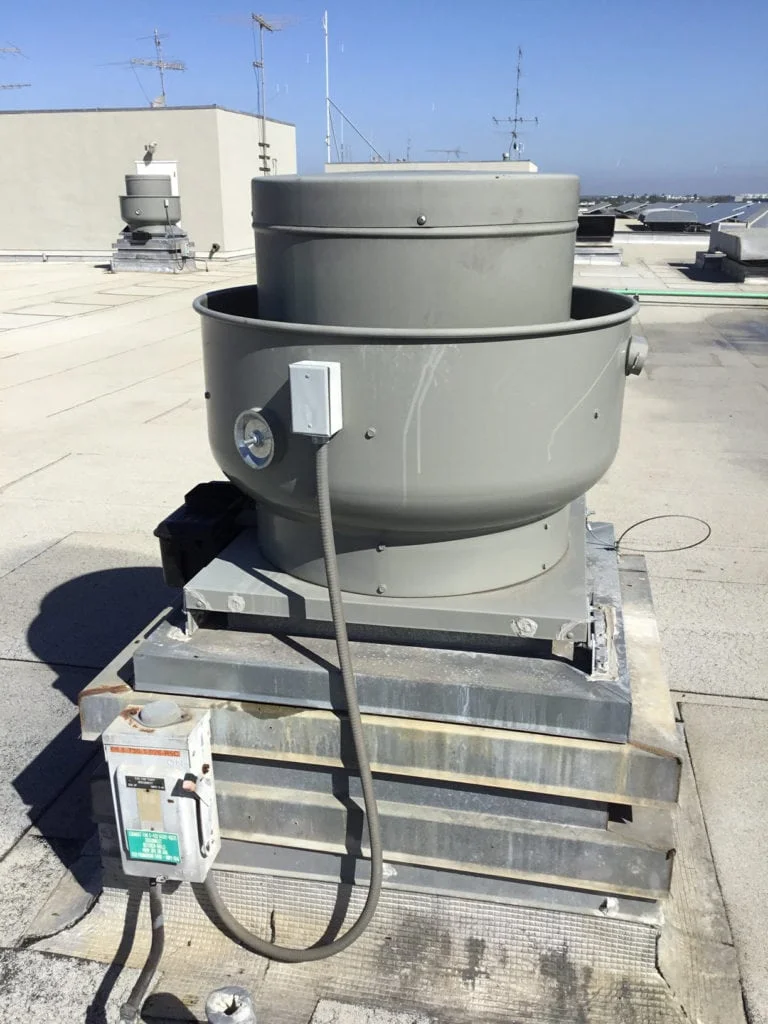
Strobic high-plume dilution exhaust fans are engineered to safely discharge contaminated laboratory air, propelling it at high velocities far above the building's roofline to prevent re-entrainment into fresh air intakes or adjacent structures. This is especially vital in dense urban areas of Southern California where laboratories are often located. These robust fans handle corrosive airstreams from fume hoods, requiring specialized materials and coatings to resist chemical attack, particularly from perchloric acid or other aggressive reagents, necessitating specific maintenance protocols for welded stainless steel ductwork.
Our service extends to the comprehensive inspection and maintenance of these critical roof-mounted systems. We assess fan motor health, bearing lubrication, belt tension, and impeller integrity. Vibration analysis, adhering to ISO 20816-3, helps predict bearing failures before catastrophic breakdown. Furthermore, we meticulously inspect welded stainless perchloric and acid exhaust ductwork for any signs of corrosion or leakage, ensuring the system's structural integrity and compliance with NFPA 45, which is essential for preventing hazardous emissions and maintaining a safe laboratory environment.
Integrated System Performance & Regulatory Compliance
Effective laboratory ventilation is an integrated system, where the performance of VAV fume hood controls, exhaust ductwork, and roof-mounted fans are interdependent. A failure in one component, such as a sticky venturi valve or a degraded Strobic fan bearing, can compromise the entire system's ability to maintain safe operating conditions. Western Mechanical, Inc. approaches service with a holistic view, diagnosing issues from the hood face to the exhaust stack, ensuring seamless operation and compliance with critical standards like ANSI/AIHA Z9.5 and local SCAQMD air quality regulations.
Our preventative maintenance programs are tailored for the unique demands of Southern California's research and industrial sectors, focusing on maximizing uptime and extending equipment lifespan. By proactively addressing potential failure points and optimizing system efficiency, we help facilities reduce energy consumption and avoid costly emergency repairs. Our CSLB #618138 licensed and UA Local 250 certified technicians provide the expertise needed to ensure your laboratory ventilation systems operate safely, reliably, and in full regulatory compliance.
UA Local 250 Certified Field Diagnostic & Commissioning Protocol
Verify fume hood face velocity at multiple sash positions using an airflow capture hood (e.g., Alnor Balometer) to confirm 100 FPM +/- 10% per ANSI/AIHA Z9.5.
Execute venturi valve (Phoenix Controls/TSI) diagnostic sequence to confirm actuator response time (< 1.0 sec) and flow tracking accuracy against BAS setpoints.
Perform visual inspection and ultrasonic thickness testing on welded stainless steel perchloric/acid exhaust ductwork for corrosion, pitting, and weld integrity.
Conduct vibration analysis (e.g., Meggitt vibro-meter) on Strobic exhaust fan motor and bearings, ensuring levels are below 0.12 in/s RMS (ISO 20816-3 Cat II).
Measure Strobic fan motor amperage and voltage, calculate power factor, and compare against nameplate data to detect overloaded conditions or electrical anomalies.
Facility Director & Chief Engineer FAQs
How often should lab fume hood venturi valves be calibrated?
Venturi valves should be calibrated annually or whenever significant changes in airflow patterns or operational issues are observed. Regular calibration ensures the VAV system maintains the critical 100 FPM face velocity, crucial for laboratory safety and compliance with ANSI/AIHA Z9.5 standards and energy efficiency mandates.
What are the risks of neglected Strobic exhaust fan maintenance?
Neglected Strobic fan maintenance can lead to catastrophic bearing failure, impeller imbalance, reduced exhaust capacity, and potential re-entrainment of hazardous fumes. This compromises lab safety, increases energy consumption due to inefficient operation, and can result in costly emergency repairs and facility downtime.
Do you service specialized perchloric acid fume hood exhaust systems?
Yes, Western Mechanical, Inc. specializes in servicing perchloric acid fume hood exhaust systems, which require welded stainless steel ductwork and specific wash-down capabilities. Our UA Local 250 journeymen are experienced in inspecting and maintaining these critical systems to NFPA 45 standards, ensuring safe operation.
How does VAV fume hood service impact energy efficiency?
Proper VAV fume hood service, including venturi valve calibration and Strobic fan optimization, directly impacts energy efficiency. By ensuring precise airflow control, systems only exhaust the necessary air volume, reducing the load on HVAC systems and lowering utility costs, aligning with Title 24 Part 6 requirements.
Acton Headquarters & 24/7 Southern California Dispatch
Western Mechanical, Inc. • 2210 Soledad Canyon Road, Suite O, Acton, CA 93510 • Primary Phone: (661) 251-0111 • 24/7 Toll-Free: (800) 585-5085 • CSLB #618138 (C-20, C-38, C-4)