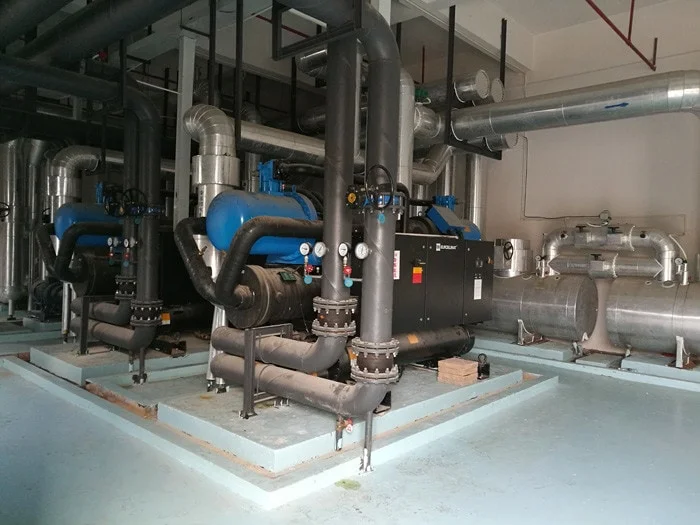
Expert diagnosis and repair for walk-in freezer evaporator ice blockages caused by defrost system failures, uninsulated strip curtains, and drain line issues in -10°F warehouses.
Direct Engineering Summary
Solid ice blocks on commercial freezer coils are typically caused by failed defrost heaters, faulty Klixon fan-delay/termination thermostats, or compromised thermal envelopes such as uninsulated strip curtains. Western Mechanical, Inc. diagnoses open calrod defrost elements, verifies proper heated drain line pitch, and ensures optimal defrost cycles to maintain -10°F warehouse temperatures. Our UA Local 250 journeymen utilize precision instrumentation to restore critical refrigeration performance, adhering to ASHRAE 15 and Title 24 Part 6 standards. Contact us at (661) 251-0111 for CSLB #618138 certified service.
The formation of solid ice blocks on commercial freezer evaporator coils is a critical refrigeration failure mode, often stemming from compromised defrost cycles. Calrod defrost elements, typically rated for 208-240V, are designed to melt accumulated frost during timed defrost periods. An open circuit within a calrod element, verifiable with an ohmmeter, prevents heat generation, leading to progressive ice accretion. Similarly, a failed Klixon fan-delay/termination thermostat, which senses coil temperature, can prematurely terminate the defrost cycle or fail to initiate the fan-delay, allowing residual ice to persist and compound with subsequent cycles. These components are essential for maintaining the -10°F setpoint common in industrial freezers.
Accurate diagnosis requires isolating the defrost circuit and performing continuity and resistance checks on individual heater elements and the Klixon thermostat. A common issue observed by Western Mechanical, Inc. UA Local 250 journeymen is a thermostat stuck open, preventing the defrost from completing, or stuck closed, causing excessive defrost run times and potential product temperature fluctuations. Given Southern California's high ambient humidity, even minor defrost inefficiencies can rapidly escalate into severe ice blockages, reducing airflow across the coil, decreasing heat transfer efficiency, and ultimately leading to elevated box temperatures and increased energy consumption, directly impacting operational ROI.
Impact of Uninsulated Strip Curtains & Door Seals
Beyond internal defrost system components, the thermal integrity of the freezer envelope significantly influences ice buildup. Uninsulated or damaged strip curtains on walk-in freezer doors serve as a primary conduit for warm, humid ambient air ingress into the -10°F environment. Each time the door opens, latent heat and moisture rapidly infiltrate, condensing and freezing on the coldest surfaces – the evaporator coils. While strip curtains are not designed for absolute airtightness, their efficacy relies on proper material selection, full overlap (minimum 50%), and intact condition to minimize air exchange. Degraded or missing strips negate their thermal barrier function, placing undue load on the refrigeration system and accelerating ice formation.
Western Mechanical, Inc. routinely identifies and rectifies issues with compromised door seals and strip curtains as a root cause of evaporator icing. The thermodynamic principle is simple: every pound of water vapor entering the freezer at 70°F and 50% RH carries approximately 1000 BTUs of latent heat that must be removed, plus the sensible heat to cool it to -10°F. This additional load directly translates to longer compressor run times and increased defrost frequency, which the system may not be designed to handle. Proper sealing and insulation are paramount for maintaining temperature stability, reducing ice accumulation, and optimizing energy efficiency in industrial cold storage facilities, especially in the variable Southern California climate.
Heated Drain Line Integrity and Pitch for Ice Prevention
An often-overlooked aspect of freezer defrost systems is the heated drain line. During the defrost cycle, melted ice (defrost water) must be efficiently evacuated from the freezer. If the drain line is unheated, improperly pitched, or clogged, defrost water can refreeze within the line, creating an ice dam. This dam causes water to back up into the evaporator pan, where it subsequently refreezes, contributing significantly to the formation of solid ice blocks around the coil and fan motors. Proper drain line heating, typically via self-regulating heat trace cable or embedded resistance wire, ensures that water remains liquid until it exits the freezer environment, preventing refreeze.
Our UA Local 250 technicians at Western Mechanical, Inc. meticulously inspect drain line integrity, verifying that the heat trace is operational and that the line maintains a minimum pitch of 1/4 inch per foot to ensure gravity-assisted drainage. A common failure point is damage to the heat trace insulation or element, or a lack of proper insulation around the drain line itself, allowing heat to dissipate too quickly in the extreme cold. Addressing these issues is critical for preventing recurrent ice blockages and maintaining the continuous, efficient operation of commercial freezers, safeguarding perishable inventory and reducing the risk of costly downtime for facilities operating under CSLB #618138 compliance.
UA Local 250 Certified Field Diagnostic & Commissioning Protocol
Verify defrost heater element resistance (ohms) against OEM specifications using a digital multimeter, ensuring continuity and proper power draw.
Test Klixon fan-delay/termination thermostat operation by manually heating the sensor and confirming switch actuation at specified temperature (e.g., 45°F).
Inspect all walk-in freezer door strip curtains for full overlap (min. 50%), tears, or missing strips, and verify proper sealing around the entire door perimeter.
Confirm heated drain line continuity and current draw for heat trace operation, and visually inspect drain line for correct pitch (min. 1/4 inch per foot) to prevent standing water.
Monitor evaporator coil fin temperature during and after defrost cycle using an infrared thermometer to ensure complete ice melt and proper fan-delay initiation.
Facility Director & Chief Engineer FAQs
Why do my freezer coils keep icing up despite running defrost cycles?
Persistent icing often indicates a failed defrost heater element, a faulty defrost termination thermostat (Klixon), or excessive infiltration of warm, humid air. Western Mechanical, Inc. diagnoses these specific component failures and thermal envelope breaches to restore proper operation.
How do uninsulated strip curtains contribute to freezer coil ice blocks?
Uninsulated or damaged strip curtains allow warm, humid ambient air to infiltrate the freezer. This moisture rapidly condenses and freezes on the cold evaporator coils, overwhelming the defrost system and leading to severe ice accumulation, increasing energy load.
What is the role of a heated drain line in preventing ice buildup?
A heated drain line ensures that defrost water melts and drains completely from the evaporator pan before it can refreeze. Without proper heating or pitch, water can back up, forming ice dams that contribute significantly to coil ice blocks and system inefficiency.
Can a faulty Klixon thermostat cause my freezer fans to run too early?
Yes, a faulty Klixon fan-delay thermostat can prematurely re-energize evaporator fans before the coil has completely defrosted and drained. This blows moisture back onto the coil, accelerating ice buildup and reducing the effectiveness of subsequent defrost cycles.
Acton Headquarters & 24/7 Southern California Dispatch
Western Mechanical, Inc. • 2210 Soledad Canyon Road, Suite O, Acton, CA 93510 • Primary Phone: (661) 251-0111 • 24/7 Toll-Free: (800) 585-5085 • CSLB #618138 (C-20, C-38, C-4)