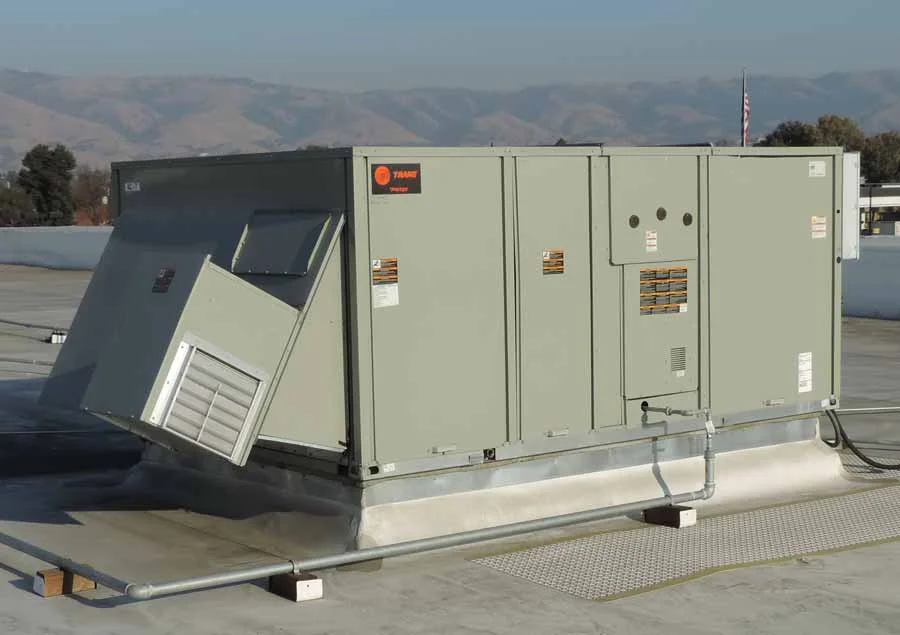
Eliminating Cold Supply-Air Dumping & Static Relief Problems in Zoned Commercial Package Units
Direct Engineering Summary
Barometric and modulating bypass dampers cause rooftop coil freezing by dumping excessively cold supply air directly into the return plenum, leading to evaporator coil icing and reduced latent cooling capacity. This issue is resolved by upgrading to static-controlled VFD blowers combined with hot-gas or digital trim bypass, ensuring precise airflow and refrigerant management. Western Mechanical, Inc., CSLB #618138, utilizes UA Local 250 journeymen for these critical retrofits, improving system efficiency and preventing freeze-ups. Contact us at (661) 251-0111 for expert solutions.
Engineering Tolerances & Governing Standards
Parameter
Specification
Standard
Minimum Evaporator Coil Temperature
38°F (3.3°C)
ASHRAE 170-2016
Duct Static Pressure Setpoint
0.8-1.2 in. w.c. (200-300 Pa)
SMACNA HVAC Duct Construction Standards
VFD Output Frequency Range
20-60 Hz
NEMA MG 1
Refrigerant Suction Superheat
8-12°F (4.4-6.7°C)
ACCA Manual J
Supply Air Temperature Differential
18-22°F (10-12.2°C)
ASHRAE 90.1-2019
The Inherent Flaws of Bypass Damper Systems in VAV Zones
Traditional variable air volume (VAV) zone systems often rely on barometric or modulating bypass dampers to manage excess airflow when zones close. While seemingly simple, this approach creates significant thermodynamic inefficiencies and operational hazards. As VAV boxes modulate closed, static pressure in the supply duct rises, forcing the bypass damper to open and dump cold supply air directly into the return plenum. This reintroduction of chilled air reduces the temperature differential across the evaporator coil, leading to dangerously low coil surface temperatures and, critically, ice formation.
The problem is exacerbated in Southern California's dry climate, where latent heat removal is less dominant, making sensible cooling paramount. When evaporator coils freeze, their capacity for both sensible and latent cooling plummets, leading to higher space temperatures, increased humidity, and ultimately, compressor failure due to liquid slugging. Western Mechanical, Inc. frequently diagnoses these issues in older commercial package units, demonstrating that the initial cost savings of bypass dampers are quickly offset by exorbitant energy bills and premature equipment breakdowns.
Engineered Solutions: VFD Blower Control & Refrigerant Management
The superior engineering solution involves replacing static relief bypass dampers with a variable frequency drive (VFD) controlling the main supply fan. A VFD precisely modulates the fan speed to maintain a constant static pressure setpoint in the supply duct, eliminating the need to dump cold air. This ensures that only the required airflow is delivered to the conditioned spaces, optimizing fan energy consumption and preventing the thermodynamic imbalance that causes coil freezing. The VFD's ability to ramp fan speed up and down dynamically provides stable airflow across the evaporator coil, maintaining optimal heat transfer efficiency.
Further enhancing this approach is the integration of advanced refrigerant management, such as hot-gas bypass or digital scroll compressor trim. Hot-gas bypass injects a small amount of hot discharge gas into the evaporator suction line, raising the suction temperature and preventing coil freeze-up during low-load conditions. Digital scroll compressors achieve similar results by unloading individual scrolls to match cooling capacity precisely to the load, avoiding excessively low suction pressures. Western Mechanical, Inc.'s UA Local 250 journeymen are experts in implementing these sophisticated controls, ensuring robust, energy-efficient operation for your commercial HVAC systems.
Lifecycle ROI and Southern California Compliance
Investing in VFD blower upgrades and advanced refrigerant controls offers substantial lifecycle return on investment for Southern California facilities. Beyond preventing costly coil freeze-ups and compressor failures, these systems dramatically reduce energy consumption. By eliminating static pressure losses and optimizing fan speed, electrical demand for the fan motor can decrease by 30-50%. Furthermore, precise temperature and humidity control improves occupant comfort and productivity, crucial for HCAI-regulated healthcare facilities or data centers where environmental stability is paramount.
Compliance with California's stringent energy codes, particularly Title 24 Part 6, is another key benefit. VFD-driven fan systems inherently meet or exceed efficiency requirements for commercial HVAC, making retrofits a strategic choice for facility upgrades. Western Mechanical, Inc., CSLB #618138, ensures all installations are performed by highly skilled UA Local 250 union journeymen, guaranteeing adherence to the highest industry standards and local regulations, delivering long-term reliability and operational savings for your commercial and industrial properties.
UA Local 250 Certified Field Diagnostic & Commissioning Protocol
Verify supply duct static pressure setpoint (0.8-1.2 in. w.c.) using a calibrated digital manometer.
Measure evaporator coil surface temperature with an infrared thermometer to confirm above 38°F (3.3°C).
Log VFD output frequency and amperage to ensure proper fan speed modulation under varying loads.
Check refrigerant suction superheat (8-12°F) at the evaporator outlet using a digital manifold gauge.
Inspect hot-gas bypass valve operation or digital scroll compressor unloading via BMS/service tool.
Facility Director & Chief Engineer FAQs
Why do bypass dampers cause my rooftop unit to freeze?
Bypass dampers recirculate cold supply air back to the return, reducing the temperature differential across the evaporator coil. This causes the coil surface temperature to drop below freezing, leading to ice formation and diminished cooling capacity.
What is a VFD upgrade and how does it prevent freezing?
A VFD (Variable Frequency Drive) upgrade controls the main supply fan speed to maintain constant duct static pressure. This eliminates the need for bypass dampers, ensuring stable airflow over the evaporator coil and preventing freeze-ups by optimizing refrigerant conditions.
Does this solution improve energy efficiency?
Absolutely. By precisely matching fan speed to cooling demand, VFD systems drastically reduce fan motor energy consumption. This, coupled with optimized refrigerant cycles, leads to significant energy savings and lower operating costs for your commercial facility.
Can Western Mechanical, Inc. implement these advanced controls?
Yes, Western Mechanical, Inc. specializes in VFD retrofits and advanced refrigerant control systems. Our UA Local 250 journeymen are highly skilled in engineering and installing these solutions for commercial and industrial HVAC systems, ensuring peak performance and reliability.
Acton Headquarters & 24/7 Southern California Dispatch
Western Mechanical, Inc. • 2210 Soledad Canyon Road, Suite O, Acton, CA 93510 • Primary Phone: (661) 251-0111 • 24/7 Toll-Free: (800) 585-5085 • CSLB #618138 (C-20, C-38, C-4)