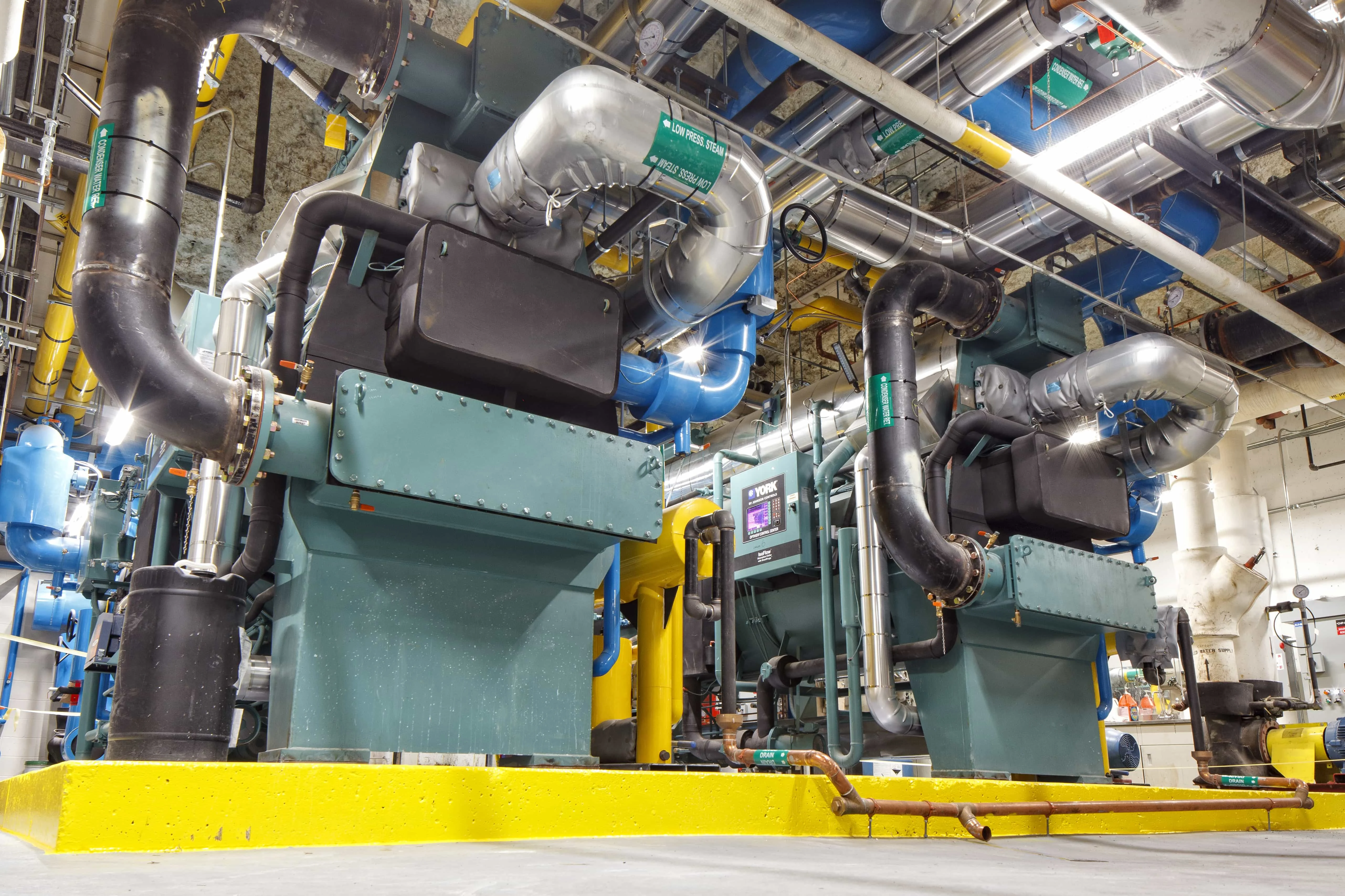
Honest Engineering Comparison for 50,000+ sq ft Buildings: R-410A/R-32 Leak Risks vs. 30-Year Welded Hydronic Plants
Direct Engineering Summary
For commercial facilities exceeding 50,000 sq ft, four-pipe hydronic chiller/boiler systems offer superior lifecycle value and safety compliance compared to Variable Refrigerant Flow (VRF) systems, primarily due to ASHRAE 15 refrigerant concentration limits and inherent leak risks from extensive field-brazed R-410A/R-32 piping. Hydronic systems, installed by UA Local 250 journeymen, typically achieve 30-year lifespans versus 12-15 years for VRF. Western Mechanical, Inc. provides expert installation and service, CSLB #618138, (661) 251-0111.
ASHRAE 15 Compliance and Refrigerant Safety for Large Facilities
The critical differentiator between VRF and hydronic systems for large commercial and industrial applications exceeding 50,000 sq ft lies in ASHRAE 15-2019 safety standards concerning refrigerant concentration limits. VRF systems, by design, circulate significant volumes of R-410A or R-32 refrigerant through extensive field-brazed copper piping networks, often spanning hundreds or thousands of linear feet. This necessitates meticulous calculation of refrigerant charge per occupied space volume to prevent exceeding the Refrigerant Concentration Limit (RCL) of 26 lbs/1000 ft³ for R-410A, a threshold frequently challenged in densely occupied zones or smaller rooms served by long VRF runs.
The inherent risk of multiple field-brazed joints, flare connections, and branch selector boxes in VRF systems creates numerous potential leak points, directly impacting ASHRAE 15 compliance. A single, significant leak can quickly exceed the RCL in a confined space, posing a serious safety hazard and requiring costly refrigerant recovery and system repair. Hydronic systems, conversely, contain refrigerant solely within the chiller plant, utilizing water or glycol for heat transfer, thereby eliminating refrigerant safety concerns within occupied spaces and simplifying compliance for complex facility layouts.
Lifecycle Costs, Longevity, and Maintenance Complexity
Beyond initial capital expenditure, the lifecycle cost analysis heavily favors four-pipe hydronic chiller/boiler plants for large-scale commercial HVAC. Hydronic systems, constructed with robust, welded steel or copper piping, are engineered for a 30-year operational lifespan, often exceeding this with proper maintenance. Key components like chillers, boilers, and pumps are designed for repairability, allowing for component replacement rather than full system overhaul. This extended lifespan significantly amortizes the initial investment and reduces long-term operational expenses.
VRF systems, while offering zone-level control, typically have a service life of 12-15 years due to the complex electronics, numerous compressors, and the cumulative stress on refrigerant lines and expansion valves. The distributed nature of VRF places hundreds of potential failure points across the building, leading to higher diagnostic complexity and component replacement costs. Furthermore, the specialized nature of VRF refrigerant handling and diagnostics requires highly trained UA Local 250 journeymen, impacting maintenance budgets over the system's shorter lifespan.
Operational Efficiency and Southern California Climate Considerations
In Southern California's diverse climate, operational efficiency is paramount. While VRF systems excel at part-load efficiency for individual zones, their overall system efficiency can diminish significantly under extreme conditions or when multiple zones demand simultaneous heating and cooling, forcing compressor cycling across numerous outdoor units. This dynamic can lead to higher energy consumption compared to a centralized hydronic plant optimized for the building's aggregate load profile through efficient chillers and boilers, often leveraging variable-speed drives and advanced controls.
Hydronic systems offer superior resilience and redundancy. A centralized plant allows for N+1 redundancy for critical components, ensuring continuous operation even during equipment maintenance or failure. The thermal inertia of water also provides a more stable and consistent indoor environment, minimizing temperature swings. Western Mechanical, Inc. designs and installs hydronic systems that integrate seamlessly with Southern California's utility demands and Title 24 Part 6 energy efficiency requirements, delivering robust, long-term performance for mission-critical facilities.
UA Local 250 Certified Field Diagnostic & Commissioning Protocol
Verify ASHRAE 15 refrigerant concentration calculations for all occupied spaces in VRF designs, including worst-case leak scenarios.
Perform comprehensive leak detection on all VRF field-brazed joints and flare connections using a calibrated electronic leak detector (e.g., Inficon D-TEK Select) and nitrogen pressure testing to 400 psi.
Conduct refrigerant charge verification for VRF systems using weigh-in method, cross-referencing against manufacturer specifications and line length adjustments.
Measure and log chiller/boiler plant efficiencies (kW/ton, BTU/hr input vs. output) for hydronic systems under various load conditions.
Inspect and test all refrigerant safety alarms and ventilation interlocks on VRF systems as per ASHRAE 15 and local mechanical codes.
Facility Director & Chief Engineer FAQs
Why is ASHRAE 15 compliance more challenging for VRF in large buildings?
ASHRAE 15 limits refrigerant concentration in occupied spaces. VRF systems distribute large refrigerant charges throughout a building, increasing the likelihood of exceeding these limits in smaller rooms or in the event of a leak from extensive field-brazed piping, making compliance complex for large, multi-zone facilities.
What are the primary leak risks associated with VRF systems?
VRF systems involve thousands of field-brazed joints, flare connections, and numerous branch selector boxes. Each of these is a potential leak point for R-410A or R-32 refrigerant, contributing to higher maintenance needs and environmental impact compared to contained hydronic systems.
How does the lifespan of hydronic systems compare to VRF?
Four-pipe hydronic chiller/boiler systems are designed for a robust 30+ year lifespan, with major components often repairable or replaceable. VRF systems, with their complex electronics and distributed compressors, typically have a shorter operational life of 12-15 years before requiring significant overhaul or replacement.
Can VRF systems be energy efficient for large commercial spaces?
While VRF offers excellent part-load efficiency for individual zones, its overall system efficiency in large commercial spaces can be compromised under varying or extreme loads due to complex control algorithms and numerous compressor stages. Centralized hydronic plants often achieve superior aggregate efficiency and redundancy.
Acton Headquarters & 24/7 Southern California Dispatch
Western Mechanical, Inc. • 2210 Soledad Canyon Road, Suite O, Acton, CA 93510 • Primary Phone: (661) 251-0111 • 24/7 Toll-Free: (800) 585-5085 • CSLB #618138 (C-20, C-38, C-4)