WESTERN MECHANICAL, INC. | Primary Dispatch: (661) 251-0111 | 24/7 Hotline: (800) 585-5085 | CSLB #618138 (C-20, C-38, C-4) | 100% UA Local 250 Union
Affinity Laws in Action: Converting 3-Way Coils to 2-Way Valves + VFD Pumps
Achieving 65.7% Pump Brake Horsepower Reduction and Enhanced Hydronic Efficiency
Direct Engineering Summary
Converting 3-way control valves to 2-way valves on hydronic coils, coupled with Variable Frequency Drives (VFDs) on pumps, significantly enhances system efficiency by enabling flow modulation rather than bypass. This retrofit leverages the Affinity Laws, specifically the Cube Law, where a 30% reduction in hydronic flow at part load can reduce pump brake horsepower by approximately 65.7% (0.7^3). This also eliminates return temperature blending, optimizing chiller and boiler performance. Western Mechanical, Inc., CSLB #618138, employs UA Local 250 journeymen for these precision retrofits, ensuring compliance with ASHRAE 90.1. Call (661) 251-0111 for expert service.
Engineering Tolerances & Governing Standards
Parameter
Specification
Standard
Flow Reduction (Part Load)
30% (e.g., from 100 GPM to 70 GPM)
ASHRAE 90.1-2019
Brake Horsepower Reduction (Cube Law)
65.7% (0.7^3)
Hydraulic Institute Standards
Minimum VFD Turndown
25% of full speed (20 Hz for 60 Hz system)
IEEE 519-2014
Chilled Water Delta-T Improvement
Typically 2-5°F increase
ASHRAE 170-2021
Boiler Return Temperature Increase
Minimum 120°F for condensing boilers
ASME Section IV
Understanding the Inefficiency of 3-Way Valves in Variable Flow Systems
Traditional hydronic systems often utilize 3-way control valves at coil terminals, designed to maintain constant flow through the distribution loop while modulating flow through the coil. While this approach prevents low-flow conditions for older, constant-speed pumps, it creates significant inefficiencies in modern variable-flow systems. By continuously bypassing a portion of the supply water back to the return, 3-way valves prevent the system from recognizing true part-load conditions, forcing pumps to operate at higher flows and pressures than necessary. This constant bypassing also leads to blended return water temperatures, negatively impacting chiller and boiler efficiency by reducing the effective delta-T.
The inherent flaw with 3-way valves in a variable primary flow (VPF) or variable secondary flow (VSF) system is their inability to reduce total system flow. Instead, they merely divert water, maintaining a false constant flow that prevents VFD-equipped pumps from realizing their full energy-saving potential. This means that even when a building requires only 50% of its cooling or heating capacity, the pumps might still be circulating 80-90% of the design flow, wasting substantial energy. Furthermore, the blended return water at the chiller or boiler reduces the temperature differential, forcing the central plant to work harder to achieve desired setpoints, leading to higher operational costs, especially in Southern California's demanding climate.
Leveraging Affinity Laws: The Power of 2-Way Valves and VFDs
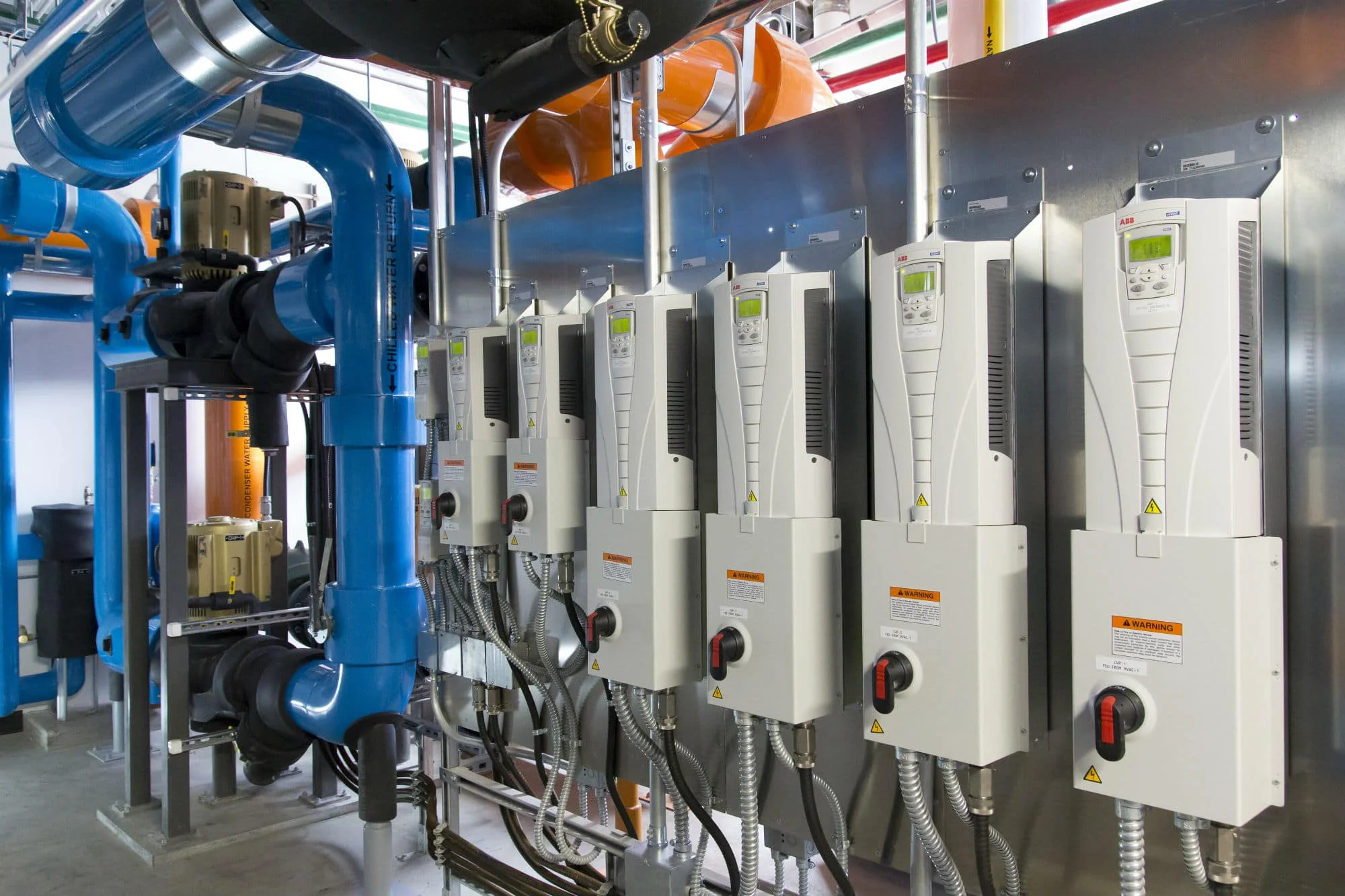
The conversion from 3-way to 2-way control valves, coupled with the implementation of Variable Frequency Drives (VFDs) on hydronic pumps, unlocks the true potential of the Affinity Laws for energy savings. When a 2-way valve closes to reduce flow to a coil, it directly reduces the total system flow. This reduction in flow signals the VFD-controlled pump to decrease its speed. According to the Affinity Laws, pump power is proportional to the cube of the speed ratio (P2/P1 = (N2/N1)^3). This means a modest reduction in flow (and thus speed) yields dramatic energy savings. For instance, a 30% reduction in flow (to 70% of design) results in a (0.7)^3 = 0.343, or 34.3% of the original power, equating to a 65.7% reduction in brake horsepower.
Beyond the significant pump energy savings, the 2-way valve retrofit eliminates the detrimental effect of return temperature blending. With 2-way valves, only the water that has exchanged heat at the coil returns to the central plant, ensuring a higher (for chilled water) or lower (for hot water) temperature differential. For chillers, this means a higher return water temperature, allowing the chiller to operate more efficiently. For condensing boilers, a lower return temperature is crucial for maximizing condensation and achieving higher thermal efficiencies, often requiring return temperatures below 130°F. Western Mechanical, Inc.'s UA Local 250 journeymen meticulously execute these retrofits, ensuring optimal system balance and adherence to ASHRAE 90.1 standards for maximum ROI.
Implementation and Lifecycle ROI for Southern California Facilities
Implementing a 3-way to 2-way valve retrofit with VFD integration requires careful planning and execution by experienced mechanical engineers. This involves detailed hydronic system analysis, sizing of new 2-way valves, VFD selection, and precise controls integration to ensure stable system operation. For facilities in Southern California, where energy costs are a significant operational expense, these retrofits offer a compelling lifecycle return on investment. The combined savings from reduced pump energy consumption and improved chiller/boiler efficiency can lead to payback periods as short as 2-4 years, depending on system size and operational hours. Furthermore, these upgrades contribute to meeting stringent Title 24 Part 6 energy efficiency requirements and can qualify for utility incentives.
Western Mechanical, Inc. specializes in designing and implementing these advanced hydronic system upgrades for commercial and industrial facilities across Southern California. Our UA Local 250 signatory journeymen are experts in controls integration, hydronic balancing, and commissioning, ensuring that the theoretical energy savings predicted by the Affinity Laws are fully realized in practice. We utilize advanced instrumentation to verify flow rates, pressure differentials, and power consumption before and after the retrofit, providing transparent performance data. This commitment to precision engineering and verified results ensures that facilities achieve maximum operational efficiency, reduced carbon footprint, and substantial long-term cost savings, reinforcing our reputation as the region's premier mechanical contractor.
UA Local 250 Certified Field Diagnostic & Commissioning Protocol
Verify existing 3-way valve bypass flow rates using ultrasonic flow meter and compare to coil design flow.
Measure pump motor amperage and voltage to calculate baseline brake horsepower before retrofit.
Confirm proper VFD programming for pressure differential control (e.g., 20-30 psid across critical path) and minimum speed limits.
Perform hydronic system balancing with new 2-way valves, adjusting coil GPM to design specifications using a differential pressure manometer.
Monitor chiller/boiler return water temperatures post-retrofit to confirm improved delta-T and central plant efficiency gains.
Facility Director & Chief Engineer FAQs
What is the primary benefit of converting 3-way to 2-way valves?
The primary benefit is enabling true variable flow in hydronic systems, allowing VFD-controlled pumps to reduce speed and energy consumption drastically. It also prevents return temperature blending, optimizing chiller and boiler efficiency by maintaining proper delta-T.
How significant are the energy savings from this retrofit?
Energy savings are substantial due to the Affinity Laws. For example, a 30% reduction in hydronic flow at part load can lead to approximately a 65.7% reduction in pump brake horsepower, significantly cutting electricity costs.
Does this retrofit affect system stability or control?
When properly engineered and commissioned by experts like Western Mechanical, Inc., this retrofit enhances system stability and control. Modern DDC systems can precisely manage 2-way valves and VFDs, ensuring optimal comfort and efficiency without hunting.
Is this retrofit suitable for all hydronic systems?
While highly beneficial for most modern variable-flow hydronic systems, a detailed engineering assessment is crucial. Systems with very low delta-T or specific process requirements may need tailored solutions. Western Mechanical, Inc. provides comprehensive evaluations.
Acton Headquarters & 24/7 Southern California Dispatch
Western Mechanical, Inc. • 2210 Soledad Canyon Road, Suite O, Acton, CA 93510 • Primary Phone: (661) 251-0111 • 24/7 Toll-Free: (800) 585-5085 • CSLB #618138 (C-20, C-38, C-4)