WESTERN MECHANICAL, INC. | Primary Dispatch: (661) 251-0111 | 24/7 Hotline: (800) 585-5085 | CSLB #618138 (C-20, C-38, C-4) | 100% UA Local 250 Union
Gravel Noise in Chilled & Condenser Water Pumps: Cavitation vs. Air Entrainment
Diagnosing Suction Recirculation, NPSH Margin Deficiencies, and Vortexing in Industrial Hydronic Systems
Direct Engineering Summary
Gravel noise in chilled and condenser water pumps typically indicates either cavitation or air entrainment, both stemming from insufficient net positive suction head (NPSH) or system anomalies. Cavitation occurs when NPSHa drops below NPSHr, causing vapor bubble formation and collapse, while air entrainment introduces free air, often from vortexing sumps or leaky suction lines. Western Mechanical, Inc. (CSLB #618138) diagnoses these issues by calculating NPSHa, inspecting suction headers, and resolving conditions like clogged diffusers or throttled valves to restore proper hydronic operation. Our UA Local 250 journeymen ensure optimal pump performance. Call (661) 251-0111.
Engineering Tolerances & Governing Standards
Parameter
Specification
Standard
Minimum NPSH Margin
1.2 to 2.0 times NPSHr (or 3-5 ft absolute)
Hydraulic Institute (HI) Standard 9.6.3
Maximum Allowable Air Content (by volume)
0.5% to 2.0% (system dependent)
ASHRAE Guideline 12-2020
Vortex Breaker Submergence
Minimum 1.5D to 2.0D (D=pipe diameter)
HI Standard 9.8
Suction Velocity (Open Systems)
3-5 ft/s (0.9-1.5 m/s)
ASHRAE Handbook - HVAC Systems & Equipment
System Pressure Fluctuation (Suction)
Less than 0.5 psi (3.5 kPa) peak-to-peak
ISO 20816-3 (Vibration Severity)
Distinguishing Cavitation from Air Entrainment in Hydronic Pumps
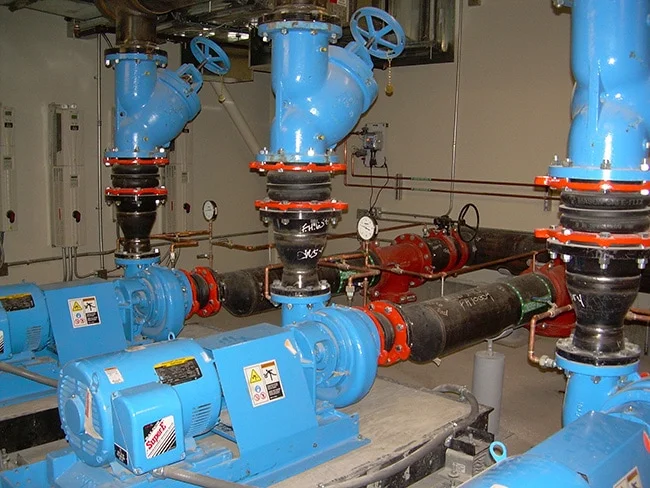
The 'gravel noise' emanating from a chilled or condenser water pump is a critical indicator of underlying hydraulic instability, primarily either cavitation or air entrainment. Cavitation arises when the Net Positive Suction Head Available (NPSHa) falls below the Net Positive Suction Head Required (NPSHr) by the pump, causing localized pressure drops within the impeller eye. This reduction below the fluid's vapor pressure leads to the formation of vapor bubbles, which then rapidly collapse as they move into higher pressure regions, generating shockwaves that erode impeller surfaces and produce the characteristic noise. Diagnosing this requires precise pressure and temperature measurements to calculate NPSHa accurately against the pump's published NPSHr curve.
Conversely, air entrainment introduces free air into the pump suction, often due to vortexing in low-level sumps, leaky suction piping connections, or inadequate air separation devices. While also producing a rattling or gravel-like sound, air entrainment typically results in a more erratic, 'spongy' feel to the pump's operation and can cause significant performance degradation, including reduced flow and head. Unlike cavitation, which is a phase change phenomenon, air entrainment involves the physical introduction of a non-condensable gas. Western Mechanical, Inc. utilizes ultrasonic leak detection and thermal imaging to pinpoint air ingress points, especially critical in large open-loop condenser water systems common in Southern California's industrial facilities.
Analyzing NPSH Margin and Suction Header Integrity
Maintaining an adequate NPSH margin is paramount for pump longevity and efficiency. For open cooling tower systems, calculating NPSHa involves atmospheric pressure, static head (positive or negative), and friction losses in the suction piping, all adjusted for the water's vapor pressure at operating temperature. A common issue is insufficient submergence in the cooling tower sump, which can lead to vortexing and air ingestion, effectively reducing NPSHa. Our UA Local 250 journeymen meticulously evaluate sump design, including the presence and effectiveness of anti-vortex plates, and assess the impact of fluctuating water levels on the available suction head.
Beyond the sump, the integrity of the entire suction header significantly impacts NPSHa. Clogged suction diffusers, often due to sediment or biological growth in condenser water loops, create excessive pressure drops. Similarly, partially throttled suction valves, sometimes left inadvertently after maintenance, restrict flow and increase velocity, leading to localized pressure drops that invite cavitation. Western Mechanical, Inc. employs differential pressure gauges and flow meters to map friction losses across suction components, ensuring that the system's design and operational parameters align with the pump's NPSHr requirements, especially vital for high-volume pumps operating in the demanding Southern California climate.
Troubleshooting Vortexing, Clogged Diffusers, and Throttled Valves
Addressing vortexing in cooling tower sumps is a critical step in mitigating air entrainment. Vortexing occurs when the fluid velocity near the suction inlet is high, and the submergence is insufficient, drawing air down into the suction line. Solutions range from installing properly sized anti-vortex plates or hoods to raising the minimum operating water level in the sump. For existing installations, our engineers may recommend modifying the suction bell geometry or relocating the suction inlet to ensure laminar flow conditions and prevent air ingress, a common problem in older, less optimally designed industrial cooling systems.
Clogged suction diffusers and inadvertently throttled suction valves are mechanical obstructions that directly reduce NPSHa. A routine inspection by a UA Local 250 technician includes checking the differential pressure across suction diffusers and strainers. An abnormally high pressure drop indicates fouling that requires cleaning. Similarly, confirming that all suction isolation valves are fully open and their position indicators are accurate is a fundamental diagnostic step. These seemingly simple issues are frequently overlooked, yet they are often the root cause of severe cavitation and premature pump failure, leading to costly downtime for Southern California's critical facilities. Western Mechanical, Inc. provides comprehensive diagnostics and remediation services, CSLB #618138.
UA Local 250 Certified Field Diagnostic & Commissioning Protocol
Measure pump suction and discharge pressure simultaneously using calibrated gauges to calculate differential head and identify potential suction anomalies.
Verify NPSHa by measuring suction pressure, water temperature, and static head, then compare against pump's published NPSHr curve.
Inspect cooling tower sump for vortexing, ensuring adequate submergence (min. 1.5D to 2.0D) and proper functioning of anti-vortex devices.
Utilize an ultrasonic flowmeter to confirm actual flow rates through the pump and compare to design specifications, checking for discrepancies caused by restrictions.
Perform a thermal scan of the pump casing and suction piping to detect localized cold spots indicative of vapor bubble collapse (cavitation) or air pockets.
Facility Director & Chief Engineer FAQs
What is the primary difference between pump cavitation and air entrainment?
Cavitation is the formation and collapse of vapor bubbles due to low pressure (below vapor pressure) within the pump, often from insufficient NPSH. Air entrainment is the physical introduction of free air into the suction line, typically from leaks or vortexing, causing similar noise and performance issues but not involving a phase change.
How does a cooling tower sump's water level affect pump cavitation?
A low water level in a cooling tower sump reduces the static head component of NPSHa. Insufficient submergence can also lead to vortexing, drawing air into the suction line, which exacerbates both cavitation potential and air entrainment, severely impacting pump performance and lifespan.
Can a partially closed suction valve cause cavitation?
Yes, a partially closed suction valve creates a restriction, increasing velocity and friction losses upstream of the pump impeller. This can significantly reduce the pressure at the impeller eye, dropping NPSHa below NPSHr and inducing cavitation, leading to noise and damage.
What maintenance prevents gravel noise in chilled water pumps?
Regular maintenance includes verifying adequate NPSH margin, inspecting suction strainers and diffusers for fouling, checking for air leaks in suction piping, ensuring proper sump submergence, and confirming all suction valves are fully open. Western Mechanical, Inc. provides these critical services.
Acton Headquarters & 24/7 Southern California Dispatch
Western Mechanical, Inc. • 2210 Soledad Canyon Road, Suite O, Acton, CA 93510 • Primary Phone: (661) 251-0111 • 24/7 Toll-Free: (800) 585-5085 • CSLB #618138 (C-20, C-38, C-4)