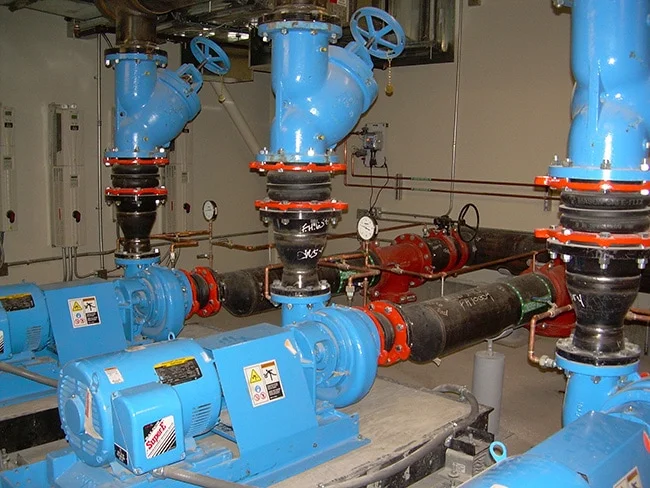
Optimizing Chilled and Hot Water Systems with Calibrated Balancing Venturi Valves and VFDs
Direct Engineering Summary
Throttling pump discharge with triple-duty valves wastes significant horsepower by creating unnecessary pressure drop, leading to increased energy consumption and reduced pump longevity. Modern alternatives, such as silent wafer checks coupled with calibrated balancing venturi valves and Variable Frequency Drives (VFDs), precisely control flow while minimizing head loss. Western Mechanical, Inc. (CSLB #618138) implements these solutions, leveraging UA Local 250 journeymen to achieve optimal system efficiency and energy savings, often reducing pump energy by 30-50%. Contact us at (661) 251-0111 for expert hydronic system upgrades.
Engineering Tolerances & Governing Standards
Parameter
Specification
Standard
Triple-Duty Valve Cv Reduction
Typically 30-50% inherent Cv reduction at full open
Hydraulic Institute (HI) Standards
Venturi Balancing Valve Accuracy
Flow measurement accuracy +/- 1-2% of reading
ASHRAE Guideline 1.1-2007
Pressure Drop (Throttled)
Up to 15-20 feet of head (45-60 kPa) wasted
ANSI/HI 9.6.3-2017
VFD Energy Savings Potential
Up to 50% for 20% flow reduction (affinity laws)
IEEE 519-2014
Minimum Flow Rate (Chiller)
Typically 2.4 GPM/ton (0.043 L/s/kW) for evaporator
ASHRAE 90.1-2019
The Inefficiency of Triple-Duty Valves in Hydronic Systems
Traditional triple-duty valves combine a check valve, shut-off valve, and throttling valve into a single unit, often installed on the discharge side of hydronic pumps. While seemingly convenient, their inherent design compromises efficiency. The throttling function, often achieved via a globe valve mechanism, creates substantial and unnecessary pressure drop even when fully open. This fixed resistance forces the pump to operate at a higher head than required, directly translating to wasted electrical energy and increased motor load. For a typical commercial chilled water system in Southern California, where cooling demands fluctuate significantly, this constant energy penalty becomes a major operational cost.
Consider a system designed for 100 feet of head, where a triple-duty valve introduces an additional 15 feet of head due to its throttling characteristics. This additional resistance requires the pump to consume disproportionately more power, following the pump affinity laws where power is proportional to the cube of the head. Over time, this cumulative energy waste can be substantial, especially for large central plants serving HCAI facilities or industrial complexes. Furthermore, the turbulent flow generated by throttling can accelerate wear on pump impellers and piping, reducing the overall lifespan of critical hydronic components and increasing maintenance frequency for Western Mechanical, Inc. clients. We prioritize solutions that mitigate these long-term operational burdens.
Modern Alternatives: VFDs and Calibrated Balancing Venturi Valves
A superior approach to hydronic system control involves decoupling the check valve, shut-off valve, and flow balancing functions. By replacing the triple-duty valve with a silent wafer check valve and a separate, highly accurate calibrated balancing venturi valve, significant efficiency gains are realized. Silent wafer checks provide essential backflow prevention with minimal pressure drop, typically less than 1 foot of head. Calibrated balancing venturi valves, on the other hand, offer precise flow measurement and adjustment with a much lower and more predictable head loss compared to globe-style throttling valves, ensuring accurate system balancing without excessive energy consumption.
Integrating Variable Frequency Drives (VFDs) with these components allows for dynamic pump speed control based on real-time system demand. Instead of throttling flow and wasting energy, VFDs adjust the pump's RPM to match the exact flow requirements, leveraging the affinity laws for maximum efficiency. This strategy is particularly effective in Southern California's variable climate, where cooling loads fluctuate hourly. Western Mechanical, Inc.'s UA Local 250 journeymen are experts in VFD programming and commissioning, ensuring optimal integration and maximizing energy savings for our commercial and industrial clients. This modern approach not only reduces energy consumption but also extends pump life by allowing operation closer to its best efficiency point.
Lifecycle ROI and System Performance Enhancement
The initial investment in replacing triple-duty valves with VFDs, silent wafer checks, and calibrated balancing venturi valves yields a rapid return on investment through substantial energy savings. For commercial buildings, schools, and hospitals, the reduction in electricity consumption for pump operation can be as high as 30-50%, depending on the system's operational profile. These savings directly impact a facility's operating budget, freeing up capital for other critical infrastructure improvements. Moreover, precise flow control improves comfort conditions, reduces hot/cold calls, and enhances the overall performance and reliability of the entire hydronic system, which is crucial for maintaining consistent environmental conditions in sensitive applications.
Beyond energy savings, the enhanced control offered by VFDs and accurate balancing valves contributes to a more stable and responsive hydronic system. This translates to better temperature control, reduced thermal stress on chillers and boilers, and fewer maintenance issues. Western Mechanical, Inc. provides comprehensive engineering and installation services, ensuring that these upgrades are implemented to the highest standards, meeting or exceeding ASHRAE and Title 24 Part 6 requirements. Our CSLB #618138 licensed team ensures long-term reliability and optimal performance, providing Southern California facilities with robust, energy-efficient mechanical solutions.
UA Local 250 Certified Field Diagnostic & Commissioning Protocol
Verify existing triple-duty valve pressure drop across fully open position using calibrated differential pressure manometer.
Measure pump motor amperage and voltage to calculate baseline power consumption (kW) before modification.
Install silent wafer check valve, ensuring correct flow direction and proper flange torque per manufacturer specifications.
Install calibrated balancing venturi valve, verifying straight pipe runs upstream/downstream for accurate flow measurement.
Program VFD for pump to maintain target differential pressure or flow rate, integrating with existing BAS and optimizing ramp rates.
Facility Director & Chief Engineer FAQs
What is the primary disadvantage of a triple-duty valve?
The primary disadvantage is its inherent inefficiency. The throttling element creates significant, constant pressure drop, forcing the pump to work harder and consume more energy than necessary, even when fully open. This wastes horsepower and increases operational costs.
How much energy can be saved by switching to VFDs and modern balancing valves?
Energy savings can be substantial, often ranging from 30% to 50% for pump operations, depending on the system's load profile and original inefficiency. These savings are achieved by precisely matching pump speed to demand, rather than throttling flow.
Are these upgrades suitable for existing hydronic systems?
Absolutely. Upgrading existing hydronic systems with VFDs, silent wafer checks, and calibrated balancing venturi valves is a highly effective retrofit. Western Mechanical, Inc. specializes in these modernizations for commercial and industrial facilities, improving efficiency and reliability.
What are the benefits of a calibrated balancing venturi valve over a triple-duty valve?
Calibrated balancing venturi valves offer precise flow measurement and adjustment with significantly lower and more predictable pressure drop. This leads to more accurate system balancing, reduced energy consumption, and improved overall system control compared to the high head loss of triple-duty valves.
Acton Headquarters & 24/7 Southern California Dispatch
Western Mechanical, Inc. • 2210 Soledad Canyon Road, Suite O, Acton, CA 93510 • Primary Phone: (661) 251-0111 • 24/7 Toll-Free: (800) 585-5085 • CSLB #618138 (C-20, C-38, C-4)