WESTERN MECHANICAL, INC. | Primary Dispatch: (661) 251-0111 | 24/7 Hotline: (800) 585-5085 | CSLB #618138 (C-20, C-38, C-4) | 100% UA Local 250 Union
When to Trim an Oversized Pump Impeller vs. Installing a Variable Frequency Drive
Optimizing Hydronic Pump Performance in Constant-Flow Primary/Boiler Loops
Direct Engineering Summary
Optimizing hydronic pump performance in constant-flow primary or boiler loops often involves either trimming an oversized impeller or installing a Variable Frequency Drive (VFD). Impeller trimming is ideal for systems with consistently high differential pressure and throttled triple-duty valves, offering a permanent, energy-efficient solution per Affinity Laws. VFDs provide dynamic control for variable-flow systems or when system head changes frequently. Western Mechanical, Inc. (661) 251-0111, CSLB #618138, utilizes UA Local 250 journeymen to assess system curves and determine the optimal, most cost-effective solution, ensuring energy savings and system reliability.
Engineering Tolerances & Governing Standards
Parameter
Specification
Standard
Impeller Trim Tolerance
Minimum 0.125 inch from casing wall, 0.0625 inch increments
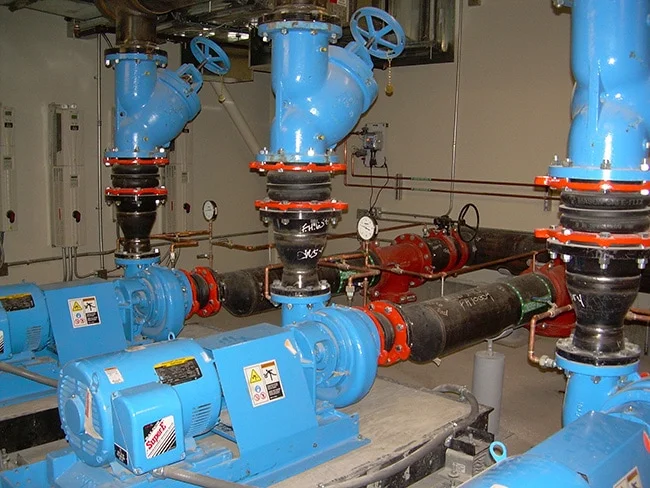
Overpumping in constant-flow hydronic systems, particularly primary boiler or chiller loops, is a significant source of wasted energy. This often occurs when pumps are specified with conservative safety factors, resulting in an oversized impeller delivering more flow and head than the system requires. A key indicator of overpumping is a heavily throttled triple-duty valve, where excessive differential pressure is dissipated across the valve, generating unnecessary friction and noise while consuming substantial electrical power. This scenario directly translates to higher utility bills, especially in Southern California's high energy cost environment.
The energy waste associated with overpumping is governed by the Affinity Laws, which state that power consumption is proportional to the cube of the impeller diameter or speed. Even a small reduction in impeller diameter or speed can yield substantial energy savings. For instance, reducing the impeller diameter by just 10% can decrease power consumption by nearly 27%. Western Mechanical, Inc. diagnoses these inefficiencies by analyzing pump head-flow curves against actual system requirements, identifying opportunities to optimize pump operation and reduce operational expenditures for our industrial and commercial clients.
Impeller Trimming: A Permanent, Efficient Solution
Impeller trimming involves physically reducing the diameter of a pump's impeller to match the actual system head and flow requirements more precisely. This method is particularly effective for constant-flow primary or boiler loops where the system's operating point is relatively stable and consistently deviates from the pump's design curve due to over-specification. By trimming the impeller, the pump's characteristic curve is permanently shifted downward, reducing both the head and flow delivered, and critically, the power consumed, without introducing complex control systems or harmonic distortions.
The process requires precise calculation based on the pump's performance curve and the actual system curve. UA Local 250 signatory journeymen from Western Mechanical, Inc. utilize specialized tools and expertise to accurately measure and trim impellers, ensuring the new operating point aligns with optimal efficiency. This approach eliminates the continuous throttling losses across control valves, leading to immediate and sustained energy savings, reduced wear on valves and piping, and a quieter system operation, making it a robust solution for long-term energy efficiency in industrial mechanical plants.
VFDs vs. Impeller Trimming: When to Choose Which
While impeller trimming offers a permanent solution for consistently oversized pumps in constant-flow applications, Variable Frequency Drives (VFDs) provide dynamic control for systems with fluctuating load demands. VFDs alter pump speed, allowing the pump to precisely match the system's varying flow and head requirements, making them ideal for variable-air-volume (VAV) systems, chilled water systems with modulating valves, or applications where the system curve frequently changes. The energy savings from a VFD also follow the Affinity Laws, as power is proportional to the cube of the speed reduction.
The decision between impeller trimming and VFD installation hinges on the application's specific characteristics and lifecycle cost analysis. For constant-flow primary boiler or chiller loops where overpumping is consistent and throttling losses are high, impeller trimming is often the most cost-effective and simplest long-term solution. For systems requiring significant turndown and frequent adjustments to flow, a VFD offers unparalleled flexibility and control. Western Mechanical, Inc. provides comprehensive engineering assessments to determine the optimal strategy, ensuring compliance with ASHRAE 90.1 and maximizing ROI for our Southern California industrial and commercial clients.
UA Local 250 Certified Field Diagnostic & Commissioning Protocol
Measure pump differential pressure across the pump and across the triple-duty valve using calibrated pressure gauges to quantify throttling losses.
Verify pump motor amperage and voltage with a true-RMS clamp meter to calculate actual power consumption (kW) before and after intervention.
Obtain pump manufacturer's performance curve and overlay actual system operating point to determine magnitude of overpumping.
Perform a system curve analysis by varying flow (if possible) and measuring corresponding head to establish actual system resistance.
Conduct post-trim/VFD commissioning: verify new operating point, measure motor current, and confirm stable system differential pressure.
Facility Director & Chief Engineer FAQs
What is the primary benefit of impeller trimming over a VFD for a constant-flow boiler loop?
For constant-flow boiler loops with persistent overpumping, impeller trimming offers a simpler, permanent mechanical solution. It eliminates continuous throttling losses without introducing electrical harmonics or the complexity of VFD controls, resulting in sustained energy savings and reduced maintenance on control valves.
How much energy can be saved by trimming an oversized pump impeller?
Energy savings from impeller trimming are substantial, governed by the Affinity Laws. A 10% reduction in impeller diameter can lead to approximately a 27% reduction in power consumption (kW), assuming the pump operates at the new, more efficient point on the system curve.
Are there any risks associated with trimming a pump impeller?
Improper impeller trimming can lead to cavitation, reduced efficiency, or structural imbalance. Western Mechanical, Inc. uses UA Local 250 certified journeymen who follow precise calculations and machining tolerances (e.g., 0.0625-inch increments) to ensure optimal performance and avoid detrimental effects.
When would a VFD be a better choice than impeller trimming for pump optimization?
A VFD is superior for variable-flow systems, such as chilled water loops with fluctuating loads or systems where the system head curve changes frequently. VFDs provide dynamic, real-time flow and pressure control, optimizing pump speed to meet precise demand and maximizing energy efficiency across varying operating conditions.
Acton Headquarters & 24/7 Southern California Dispatch
Western Mechanical, Inc. • 2210 Soledad Canyon Road, Suite O, Acton, CA 93510 • Primary Phone: (661) 251-0111 • 24/7 Toll-Free: (800) 585-5085 • CSLB #618138 (C-20, C-38, C-4)