WESTERN MECHANICAL, INC. | Primary Dispatch: (661) 251-0111 | 24/7 Hotline: (800) 585-5085 | CSLB #618138 (C-20, C-38, C-4) | 100% UA Local 250 Union
Restoring Deep 8-Row Chilled-Water Coils Without Folding Aluminum Fins Flat
Advanced techniques for removing fin fouling and chemical foaming in commercial HVAC systems, preserving coil integrity.
Direct Engineering Summary
Restoring deep 8-row chilled-water coils involves using specialized non-acid expanding coil cleaners and nitrogen blowouts, followed by opposite-airflow counter-flushing, to safely remove fin fouling and chemical foaming. This method avoids high-pressure washing exceeding 150 psi, which can damage delicate aluminum fin collars. Western Mechanical, Inc., CSLB #618138, employs UA Local 250 journeymen for this precision work, ensuring coil integrity and optimal heat transfer efficiency. Contact us at (661) 251-0111 for expert coil restoration services.
Engineering Tolerances & Governing Standards
Parameter
Specification
Standard
Maximum Safe Pressure Wash
150 psi (10.3 bar)
ASHRAE 170 / Manufacturer Guidelines
Fin Thickness (Typical)
0.004 - 0.006 inches
HVAC Coil Design Specifications
Coil Depth (8-Row)
8 to 12 inches
Commercial Chilled Water Coil Standards
Airflow Pressure Drop (Clean Coil)
< 0.5 inches w.g.
ASHRAE 90.1 / SMACNA
Recommended Cleaning Agent pH
7.0 - 8.5 (Non-Acidic)
EPA Safer Choice / OEM Guidelines
Understanding Fin Fouling and Its Impact on Coil Performance
Fin fouling, a pervasive issue in deep 8-row chilled-water coils, significantly degrades heat transfer efficiency by creating an insulating layer and increasing airflow resistance. Particulate matter, biological growth, and chemical residues accumulate within the tightly packed aluminum fins, reducing the effective surface area for heat exchange. This leads to higher fan energy consumption due to increased static pressure drop across the coil, and elevated chilled water temperatures, ultimately impacting the entire building's cooling capacity and operational costs in Southern California's demanding climate.
The physics of fin fouling involves both mechanical obstruction and thermal insulation. As dirt and grime build up, the boundary layer for heat transfer thickens, impeding the sensible and latent heat exchange between the air stream and the chilled water. This forces the chiller to work harder, consuming more electricity, and potentially shortening its lifespan. Moreover, the uneven distribution of fouling can lead to localized corrosion and premature coil failure, necessitating costly repairs or complete replacement if not addressed with precise, non-destructive cleaning protocols.
The Dangers of High-Pressure Washing on Delicate Coil Fins
While seemingly effective, using high-pressure washers exceeding 150 psi on deep 8-row coils poses a significant risk to the delicate aluminum fin collars and the overall structural integrity of the coil. The intense water jet can bend or flatten the fins, closing off critical airflow passages and permanently damaging the fin-to-tube bond, which is essential for efficient heat transfer. Once these fins are compromised, the coil's performance is irreversibly diminished, often resulting in higher energy consumption than a moderately fouled coil, making the 'cleaning' counterproductive.
The mechanical stress induced by excessive pressure can also lead to micro-fractures in the fin material or dislodge the fins from the copper tubes, compromising the thermal contact resistance. Our UA Local 250 journeymen understand that the goal is not merely to remove debris, but to preserve the coil's original geometry and thermal performance. This requires a nuanced approach that prioritizes gentle, deep-penetrating chemical action over brute force, ensuring the longevity and efficiency of the HVAC system without incurring additional maintenance burdens or replacement costs.
Advanced Restoration: Non-Acid Cleaners, Nitrogen, and Counter-Flushing
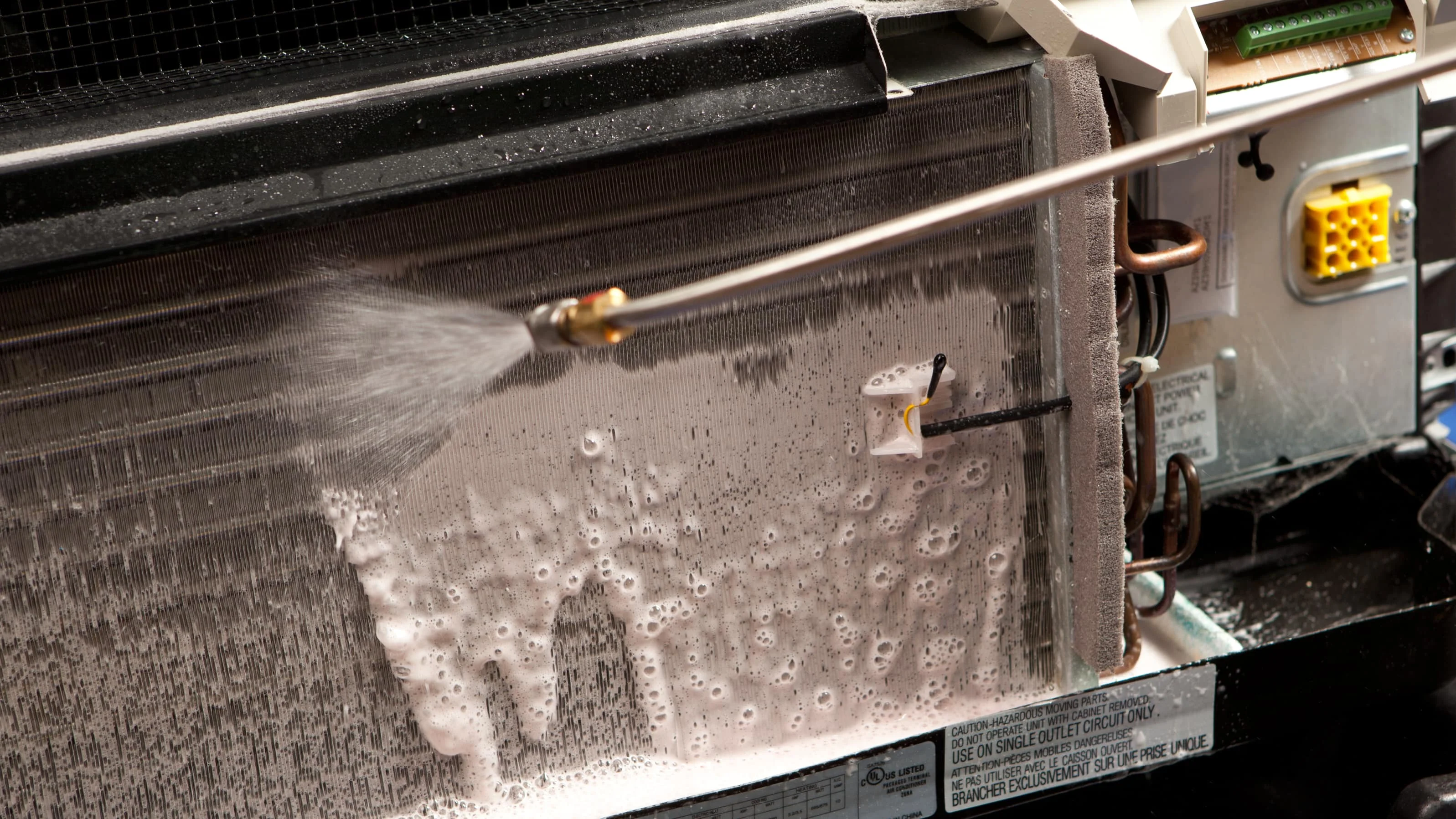
Western Mechanical, Inc. employs a superior restoration methodology for deep 8-row chilled-water coils, leveraging non-acid expanding coil cleaners that safely penetrate and lift stubborn fouling without corrosive effects. These specialized formulations expand into the coil matrix, encapsulating and breaking down dirt, biological growth, and chemical residues. This chemical action is followed by a controlled nitrogen blowout, which uses inert gas to gently dislodge and propel loosened debris from the coil's core, ensuring thorough removal without mechanical damage to the delicate fins.
The final critical step involves opposite-airflow counter-flushing, where water is introduced against the normal airflow direction. This technique ensures that trapped contaminants are flushed out effectively, preventing redeposition and ensuring a pristine coil surface. This comprehensive, multi-stage process, executed by our CSLB #618138 certified UA Local 250 technicians, restores the coil to near-original heat transfer efficiency, minimizes pressure drop, and extends the operational life of the entire chilled water system, providing significant lifecycle ROI for commercial and industrial facilities.
UA Local 250 Certified Field Diagnostic & Commissioning Protocol
Verify pre-cleaning airflow static pressure drop across coil using a digital manometer to establish baseline performance.
Apply non-acidic, expanding coil cleaner evenly, ensuring full saturation of all 8 rows and allowing adequate dwell time per manufacturer specs.
Perform controlled nitrogen blowout at < 100 psi, working systematically across the coil face to dislodge loosened contaminants.
Execute opposite-airflow counter-flushing with potable water until effluent runs clear, visually inspecting for residual fouling.
Measure post-cleaning airflow static pressure drop and compare to baseline, targeting a reduction of > 50% for optimal restoration.
Facility Director & Chief Engineer FAQs
Why are non-acidic cleaners preferred for deep coils?
Non-acidic cleaners are crucial because they prevent corrosion and damage to aluminum fins and copper tubes, which can be caused by acidic solutions. They safely expand to lift deeply embedded contaminants without compromising coil integrity or leading to premature failure, preserving the coil's thermal performance.
What is the benefit of nitrogen blowouts in coil cleaning?
Nitrogen blowouts provide a gentle yet effective method to expel loosened debris from deep within the coil matrix. Unlike high-pressure water, nitrogen is inert and dry, preventing moisture-related corrosion and ensuring thorough removal of contaminants without bending or flattening delicate fins.
How does opposite-airflow counter-flushing improve cleaning?
Counter-flushing against the normal airflow direction ensures that any remaining trapped particulates are dislodged and carried out of the coil. This technique prevents contaminants from being pushed deeper into the coil or redepositing, guaranteeing a more complete and lasting clean compared to conventional flushing.
What are the long-term benefits of proper coil restoration?
Proper coil restoration significantly reduces energy consumption by restoring optimal heat transfer and airflow, extending the lifespan of chillers and air handlers. It also improves indoor air quality, reduces maintenance calls, and ensures consistent cooling performance, providing substantial operational savings for facility directors.
Acton Headquarters & 24/7 Southern California Dispatch
Western Mechanical, Inc. • 2210 Soledad Canyon Road, Suite O, Acton, CA 93510 • Primary Phone: (661) 251-0111 • 24/7 Toll-Free: (800) 585-5085 • CSLB #618138 (C-20, C-38, C-4)