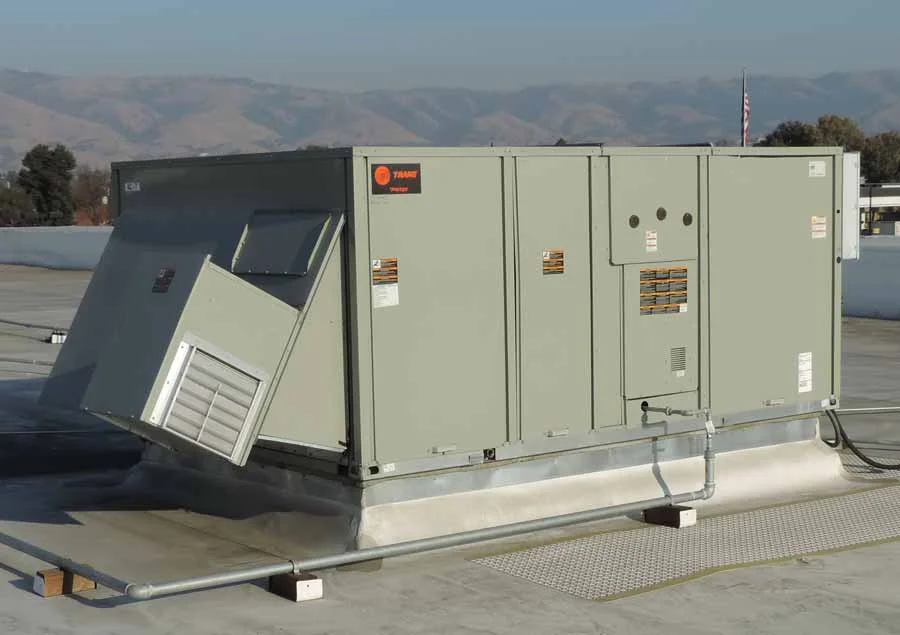
Mitigating Static Pressure Drop in Legacy Carrier/Lennox to New Trane/York/AAON RTU Swaps
Direct Engineering Summary
Cheap RTU curb adapters can introduce significant static pressure drop, often exceeding 0.50 inches water column (w.c.), by failing to account for airflow transitions between disparate legacy Carrier/Lennox footprints and new high-IEER Trane, York, or AAON units. This turbulence reduces effective airflow, compromises system efficiency, and shortens equipment lifespan. Western Mechanical, Inc., CSLB #618138, utilizes UA Local 250 journeymen to engineer custom curb adapters with optimized internal geometry, ensuring minimal pressure loss and maximum performance for Southern California's commercial and industrial facilities. Contact us at (661) 251-0111 for expert solutions.
Engineering Tolerances & Governing Standards
Parameter
Specification
Standard
Maximum Allowable Static Pressure Drop (Curb Adapter)
0.15 in. w.c. (typical design target)
ASHRAE 90.1, SMACNA HVAC Duct Construction Standards
Air Velocity at Transition Point
< 1200 FPM (optimal for minimizing turbulence)
ASHRAE Fundamentals Handbook
Duct Aspect Ratio (Post-Transition)
Max 4:1 (for uniform airflow distribution)
ACCA Manual D
Minimum Offset Angle for Airfoil Design
15 degrees (for smooth flow redirection)
Fluid Dynamics Principles
Material Gauge for Adapter Construction
18-gauge galvanized steel (minimum)
SMACNA HVAC Duct Construction Standards
The Physics of Airflow Turbulence in RTU Transitions
When replacing an aging rooftop unit (RTU) like a legacy Carrier or Lennox with a modern, high-efficiency Trane, York, or AAON system, the footprint often differs significantly. A common mistake is to utilize a generic, off-the-shelf curb adapter that prioritizes ease of installation over aerodynamic performance. These adapters frequently feature abrupt changes in cross-sectional area, sharp corners, and inadequate transition lengths, leading to severe airflow separation and vortex generation. This turbulence manifests as a substantial static pressure drop, often exceeding 0.50 inches of water column (w.c.), forcing the new RTU's fan motor to work harder, consume more energy, and ultimately deliver less conditioned air to the occupied space.
The thermodynamic consequence of this excessive pressure drop is a reduction in the system's effective capacity and efficiency, directly impacting operational costs in Southern California's demanding climate. A fan operating against higher static pressure than designed will experience increased motor amperage, leading to premature motor wear and reduced fan efficiency (e.g., a 10% increase in static pressure can lead to a 15-20% increase in power consumption). Furthermore, the uneven airflow distribution caused by turbulence can lead to hot or cold spots within the conditioned space, compromising occupant comfort and potentially violating Title 24 Part 6 energy efficiency standards if the system cannot meet design conditions.
Engineered Curb Adapters: Precision for Performance
Western Mechanical, Inc. approaches RTU replacements with a focus on engineered solutions, particularly concerning curb adapters. Our UA Local 250 signatory journeymen meticulously analyze the specific airflow requirements of the new high-IEER unit and the existing ductwork configuration. We design custom curb adapters with optimized internal geometry, incorporating features such as gradual transitions, turning vanes, and appropriate aspect ratios to minimize static pressure losses. The goal is to maintain air velocity below 1200 FPM through the adapter and limit the total pressure drop to a maximum of 0.15 inches w.c., ensuring the new RTU operates at its rated efficiency and capacity.
This precision engineering not only preserves the energy efficiency gains of the new equipment but also extends its operational lifespan by reducing stress on the fan motor and associated components. For facilities in Southern California, where utility costs are a significant concern, minimizing static pressure drop translates directly into tangible energy savings and a faster return on investment for the RTU upgrade. Our designs comply with SMACNA standards for duct construction and integrate seamlessly with building management systems to ensure optimal system control and monitoring.
Lifecycle ROI and Regulatory Compliance
Investing in a properly engineered curb adapter from Western Mechanical, Inc. significantly enhances the lifecycle Return on Investment (ROI) of a new RTU installation. Beyond the immediate energy savings, it mitigates future maintenance costs associated with overworked fan motors, bearings, and belts. For critical facilities such as HCAI-regulated healthcare environments, maintaining precise airflow and temperature control is paramount, and substandard transitions can compromise indoor environmental quality and regulatory compliance. Our solutions ensure the entire HVAC system performs as a cohesive, efficient unit, meeting stringent operational demands.
Furthermore, compliance with local energy codes and standards, including California's Title 24 Part 6, often necessitates achieving specific system efficiencies. A poorly designed curb adapter can inadvertently undermine these efforts, leading to non-compliance and potential penalties. Western Mechanical, Inc. ensures that every aspect of the RTU replacement, including the often-overlooked curb adapter, is engineered to exceed industry best practices and regulatory requirements, providing facility managers with peace of mind and optimal system performance for decades to come.
UA Local 250 Certified Field Diagnostic & Commissioning Protocol
Verify existing RTU curb dimensions and duct openings using laser measurement for precise adapter fabrication.
Conduct pre-installation static pressure mapping of existing ductwork to establish baseline and identify potential restrictions.
Perform post-installation fan curve verification using a calibrated manometer and anemometer to confirm actual static pressure and airflow.
Inspect internal geometry of fabricated curb adapter for smooth transitions, proper turning vane installation, and absence of sharp edges or obstructions.
Measure fan motor amperage and voltage under load to ensure operation within nameplate specifications and verify optimal fan efficiency.
Facility Director & Chief Engineer FAQs
Why is static pressure drop in a curb adapter so critical?
Excessive static pressure drop in a curb adapter forces the RTU's fan to work harder, consuming more energy and reducing airflow. This compromises system efficiency, shortens equipment lifespan, and can lead to uneven temperature distribution, impacting occupant comfort and increasing operational costs for commercial facilities.
How does Western Mechanical, Inc. prevent high static pressure drop?
We engineer custom curb adapters with optimized internal geometry, including gradual transitions and turning vanes, to minimize turbulence. Our UA Local 250 journeymen ensure precise fabrication and installation, aiming for a static pressure drop below 0.15 inches w.c., preserving the new RTU's efficiency.
Can a cheap curb adapter void my new RTU's warranty?
While not directly voiding a warranty, a cheap adapter causing excessive static pressure can lead to premature component failure (e.g., fan motor, belts) due to overwork. Manufacturers may deny warranty claims for failures attributed to improper installation or operating conditions outside design parameters.
What are the long-term benefits of an engineered curb adapter?
Long-term benefits include significant energy savings, extended equipment lifespan, reduced maintenance costs, consistent indoor comfort, and compliance with energy efficiency standards like Title 24 Part 6. It ensures the new RTU operates at its designed peak performance for years.
Acton Headquarters & 24/7 Southern California Dispatch
Western Mechanical, Inc. • 2210 Soledad Canyon Road, Suite O, Acton, CA 93510 • Primary Phone: (661) 251-0111 • 24/7 Toll-Free: (800) 585-5085 • CSLB #618138 (C-20, C-38, C-4)