WESTERN MECHANICAL, INC. | Primary Dispatch: (661) 251-0111 | 24/7 Hotline: (800) 585-5085 | CSLB #618138 (C-20, C-38, C-4) | 100% UA Local 250 Union
Why Office Entry Doors Blow Open During Economizer Free Cooling: Power Exhaust Fix
Diagnosing & Repairing Barometric vs. VFD-Modulated Power Exhaust Fans for Optimal Building Static Pressure
Direct Engineering Summary
Office entry doors blow open during economizer free cooling primarily due to inadequate or malfunctioning power exhaust systems, leading to building overpressure. Western Mechanical, Inc. corrects this by diagnosing and repairing barometric or VFD-modulated exhaust fans to maintain a precise building static pressure, typically +0.03 to +0.05 inches water column (w.c.) relative to outdoor reference. This ensures 100% outside air economizing without structural integrity issues or discomfort. Our UA Local 250 journeymen are CSLB #618138 certified. Contact us at (661) 251-0111.
Engineering Tolerances & Governing Standards
Parameter
Specification
Standard
Target Building Static Pressure
+0.03 to +0.05 in. w.c.
ASHRAE 90.1
Economizer Minimum Outdoor Air Damper Leakage
1% @ 1 in. w.c.
AHRI 1350
Power Exhaust Fan Control Type
Barometric or VFD-modulated
Manufacturer Specific
Differential Pressure Sensor Accuracy
0.5% of full scale
BACnet Standard 135-2016
Maximum Door Opening Force
30 lbf (interior), 15 lbf (exterior)
ADA Standards for Accessible Design
Understanding Building Overpressure & Economizer Operation
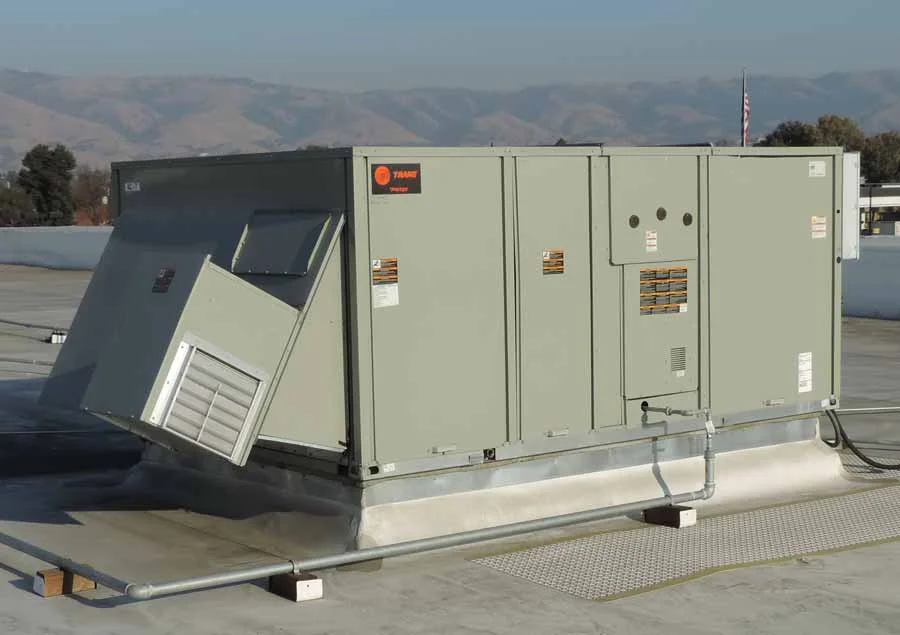
Commercial package units equipped with economizers are designed to utilize cool, dry outside air for free cooling, significantly reducing compressor run time and energy consumption. During full economization, the system can introduce up to 100% outside air. Without a properly functioning power exhaust system, this influx of air can rapidly pressurize the building envelope, creating a positive static pressure differential relative to the outdoors. This overpressure manifests as uncomfortable drafts, difficulty opening and closing doors, and in severe cases, doors blowing open unexpectedly, compromising security and thermal comfort.
The physics behind this phenomenon involves the volumetric flow rate of incoming outside air exceeding the building's natural exfiltration rate and the capacity of its exhaust systems. Southern California's climate, with its pronounced diurnal temperature swings, often presents ideal conditions for economizer operation, making robust power exhaust critical. Improperly calibrated or failed differential pressure sensors, stuck exhaust dampers, or undersized exhaust fans are common culprits. Western Mechanical, Inc. rigorously diagnoses these issues, ensuring your building's pressure profile remains within optimal operational parameters.
Barometric vs. VFD-Modulated Power Exhaust Systems
Commercial package units typically employ one of two primary power exhaust control strategies: barometric or VFD-modulated. Barometric exhaust fans utilize gravity and the building's internal pressure to open dampers, allowing air to escape when a preset pressure differential is exceeded. While simpler, these systems offer limited control precision and can be prone to sticking dampers or inconsistent performance due to wind effects. VFD-modulated power exhaust fans, conversely, are dynamically controlled by a variable frequency drive, allowing the fan speed and thus the exhaust airflow to be precisely adjusted in real-time based on input from building static pressure sensors.
The VFD-modulated approach provides superior control, maintaining a tight building pressure setpoint, typically +0.03 to +0.05 inches w.c., crucial for preventing door blow-open events and optimizing energy efficiency. Western Mechanical, Inc.'s UA Local 250 journeymen are adept at troubleshooting both types of systems, recalibrating barometric dampers, repairing VFDs, replacing faulty pressure transducers, and ensuring the exhaust fans are properly sized and integrated with the building management system (BMS). Our expertise ensures your economizer functions as intended, maximizing free cooling benefits without compromising building integrity or occupant comfort.
Precision Diagnostics & Remediation for Building Static Control
Effective remediation of building overpressure requires a methodical diagnostic approach. Our UA Local 250 technicians begin by verifying the accuracy of the building static pressure sensor, often comparing its readings against a calibrated handheld manometer with an outdoor reference probe. We inspect economizer damper linkages for binding or damage, test actuator function, and confirm proper operation of the power exhaust fan motor and VFD (if applicable). Crucially, we assess the interaction between the supply fan, return fan, and exhaust fan, as imbalances in these components directly impact building pressure.
Failure to maintain proper building static pressure not only causes discomfort but can also lead to increased infiltration of unconditioned air and moisture, impacting indoor air quality and increasing latent cooling loads. Western Mechanical, Inc. provides comprehensive repair and calibration services, ensuring that your commercial package unit's economizer and power exhaust system operate in perfect harmony. Our CSLB #618138 licensed experts restore precise control, eliminating door blow-open issues and optimizing your facility's energy performance in the demanding Southern California environment.
UA Local 250 Certified Field Diagnostic & Commissioning Protocol
Verify building static pressure sensor calibration against a calibrated handheld manometer with outdoor reference, targeting +0.03 to +0.05 in. w.c.
Inspect economizer outdoor air and return air dampers for full range of motion, proper seating, and linkage integrity.
Test power exhaust fan motor amperage and voltage, ensuring VFD output (if present) correlates with commanded speed and static pressure setpoint.
Confirm exhaust damper operation (barometric or actuated) for smooth, unimpeded airflow and proper closure when economizer is inactive.
Analyze trend data from BMS for building static pressure, supply/return fan speeds, and outdoor air conditions to identify intermittent control issues.
Facility Director & Chief Engineer FAQs
What is the ideal building static pressure for commercial facilities?
The ideal building static pressure for most commercial facilities is typically maintained at a slight positive pressure, usually +0.03 to +0.05 inches water column (w.c.) relative to the outdoors. This slight positive pressure helps prevent uncontrolled infiltration of unconditioned air and ensures proper ventilation while avoiding overpressure issues like door blow-open.
How does a faulty power exhaust system cause doors to blow open?
A faulty power exhaust system fails to adequately remove excess air introduced by the economizer, leading to a buildup of positive pressure inside the building. When this internal pressure exceeds the force holding an entry door closed, the door can be forced open, creating a hazard and compromising environmental control.
Can economizer settings contribute to building overpressure?
Yes, economizer settings can contribute to overpressure if the minimum outdoor air setpoint is too high, or if the control logic doesn't properly coordinate with the power exhaust system. An economizer introducing too much outdoor air without corresponding exhaust capacity will inevitably lead to building overpressurization.
What maintenance is required for power exhaust systems?
Regular maintenance for power exhaust systems includes inspecting fan motors and bearings, checking VFDs for proper operation, cleaning and lubricating damper linkages, verifying sensor accuracy, and ensuring exhaust grilles are clear of obstructions. Western Mechanical, Inc. provides comprehensive preventative maintenance to prevent these issues.
Acton Headquarters & 24/7 Southern California Dispatch
Western Mechanical, Inc. • 2210 Soledad Canyon Road, Suite O, Acton, CA 93510 • Primary Phone: (661) 251-0111 • 24/7 Toll-Free: (800) 585-5085 • CSLB #618138 (C-20, C-38, C-4)