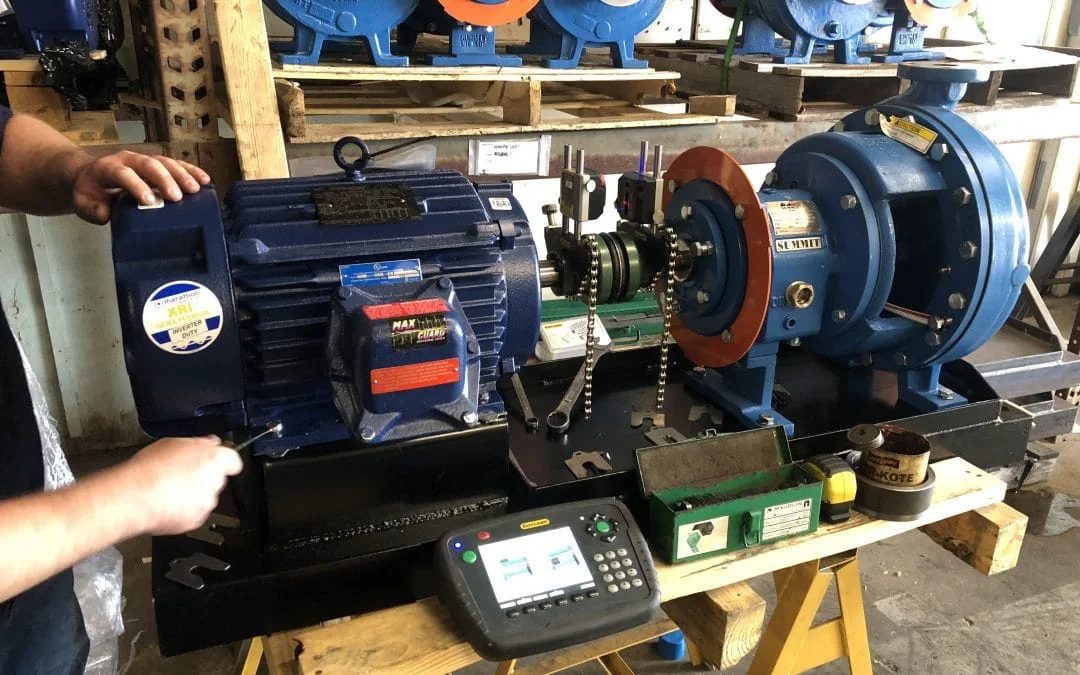
Expert analysis of FFT vibration spectra to diagnose critical centrifugal chiller component wear and prevent catastrophic failure.
Direct Engineering Summary
Centrifugal chiller FFT vibration spectra are analyzed by Western Mechanical, Inc.'s UA Local 250 journeymen to differentiate critical fault frequencies. Gear mesh frequencies, typically at 10-20 times running speed, indicate bull or pinion gear wear, while vane pass frequencies, calculated as impeller vanes multiplied by running speed, point to aerodynamic issues or impeller unbalance. Oil whirl instability, occurring at 0.42-0.48 times running speed, signifies bearing lubrication film breakdown. Early detection, adhering to ISO 20816-3 velocity limits, is crucial to prevent thrust bearing wipe and catastrophic failure. Contact Western Mechanical, Inc. (CSLB #618138) at (661) 251-0111 for expert diagnostics.
Engineering Tolerances & Governing Standards
Parameter
Specification
Standard
Gear Mesh Frequency (GMF)
N_pinion * T_pinion or N_bull * T_bull
ISO 20816-3
Vane Pass Frequency (VPF)
N_impeller * #Vanes
API 670
Oil Whirl Frequency
0.42x - 0.48x RPM
ISO 20816-3 Annex A
Overall Vibration Velocity Limit (RMS)
4.5 mm/s (0.18 in/s)
ISO 20816-3 (Rigid Support, >300kW)
Bearing Temperature Limit (Oil)
< 80°C (176°F)
ASHRAE 15 / OEM Guidelines
Understanding Gear Mesh Frequencies in Centrifugal Chillers
The accurate interpretation of Fast Fourier Transform (FFT) vibration spectra is paramount for proactive maintenance of large centrifugal chillers. Gear mesh frequencies (GMF) are a critical indicator of the health of the bull gear and pinion within the chiller's speed-increasing gearbox. These frequencies appear as distinct, high-amplitude spikes, typically at multiples of the number of teeth on the pinion or bull gear multiplied by their respective rotational speeds. For instance, if a pinion has 20 teeth and rotates at 10,000 RPM, the GMF would be 200,000 cycles per minute or 3333 Hz. Deviations from expected GMF amplitudes or the appearance of sidebands around the GMF often signal tooth wear, pitting, misalignment, or even early stages of a developing crack, demanding immediate attention to prevent catastrophic gear failure and costly downtime.
Distinguishing true gear wear from other vibration sources requires a deep understanding of the chiller's mechanical train and operating conditions. Western Mechanical, Inc.'s UA Local 250 journeymen utilize advanced vibration analysis tools to pinpoint the exact source. For example, a GMF with sidebands spaced at the running speed of the pinion or bull gear can indicate eccentricity or looseness. Changes in GMF amplitude correlated with load variations can suggest tooth contact pattern issues. In Southern California's demanding climate, where chillers often operate at near-peak capacity for extended periods, the stresses on gearbox components are significant, making precise GMF monitoring an essential part of a comprehensive predictive maintenance program to extend asset life and optimize lifecycle ROI.
Diagnosing Vane Pass Frequencies and Aerodynamic Instability
Vane pass frequencies (VPF) are another crucial component of centrifugal chiller FFT analysis, primarily indicating aerodynamic issues within the impeller and diffuser. VPF is calculated by multiplying the number of impeller vanes by the impeller's rotational speed. High amplitude spikes at VPF, or its harmonics, can signify a range of problems including impeller unbalance, erosion of impeller vanes, diffuser vane damage, or flow-induced pulsations. These aerodynamic forces can transmit significant vibratory energy through the shaft and bearings, potentially leading to premature bearing wear, seal failures, and reduced chiller efficiency. Early detection of elevated VPF allows for targeted inspection and repair, preventing secondary damage to other critical components.
Unlike gear mesh frequencies which are purely mechanical, VPF can be influenced by process parameters such as refrigerant flow rates, discharge pressure, and even fouling within the condenser or evaporator. A sudden increase in VPF might indicate a change in operating point pushing the compressor into surge or choke conditions. Our UA Local 250 technicians investigate these correlations, cross-referencing vibration data with chiller control system logs and process instrumentation. Addressing VPF issues promptly not only prevents mechanical breakdown but also restores optimal thermodynamic performance, reducing energy consumption and operational costs, a critical consideration for facilities adhering to Title 24 Part 6 energy efficiency standards in California.
Identifying Oil Whirl Instability and Thrust Bearing Protection
Oil whirl instability is a severe rotordynamic phenomenon that can rapidly lead to catastrophic thrust bearing wipe and chiller failure if not immediately addressed. This instability typically manifests as a sub-synchronous vibration frequency occurring at approximately 0.42 to 0.48 times the rotor's running speed. It arises when the hydrodynamic oil film in journal bearings loses its stability, often due to low oil pressure, high oil temperature, excessive bearing clearances, or improper lubrication properties. The rotating shaft begins to precess around the bearing centerline in a non-synchronous manner, leading to metal-to-metal contact and rapid bearing degradation. Early identification through FFT analysis is critical; once oil whirl begins, failure can occur within minutes or hours.
Western Mechanical, Inc. employs rigorous diagnostic protocols to differentiate oil whirl from other sub-synchronous events like rotor rub or looseness. The characteristic frequency range and often a sudden onset with increasing amplitude are key indicators. Our UA Local 250 experts verify oil pressure, temperature, and filter conditions, and inspect for signs of oil degradation or contamination. Preventing oil whirl is paramount for protecting the expensive thrust bearings, which absorb the axial loads generated by the impeller. Proactive oil analysis, proper bearing maintenance, and adherence to OEM lubrication specifications are essential to maintain the integrity of the hydrodynamic film and ensure the long-term reliability of the centrifugal chiller, a cornerstone of many industrial and HCAI facilities.
UA Local 250 Certified Field Diagnostic & Commissioning Protocol
Verify accelerometer mounting integrity and frequency response across 0-10 kHz range using a calibrated shaker.
Perform full-spectrum FFT analysis on bearing housings (radial and axial) with 3200-6400 lines of resolution and 16-32 averages.
Identify and trend amplitudes of 1X, 2X, Gear Mesh Frequencies (GMF), and Vane Pass Frequencies (VPF) against ISO 20816-3 limits.
Monitor for sub-synchronous peaks at 0.42-0.48X running speed, indicating potential oil whirl instability, and check oil pressure/temperature.
Correlate vibration data with chiller operating parameters (load, lift, refrigerant pressures, oil pressure) to diagnose root causes.
Facility Director & Chief Engineer FAQs
What is the primary difference between gear mesh and vane pass frequencies?
Gear mesh frequencies (GMF) originate from the interaction of gear teeth in the speed-increasing gearbox, indicating mechanical wear. Vane pass frequencies (VPF) stem from aerodynamic forces between the impeller vanes and diffuser, signaling impeller unbalance or flow issues. Western Mechanical, Inc. differentiates these to pinpoint exact fault sources.
How quickly can oil whirl lead to chiller failure?
Oil whirl is extremely destructive and can lead to catastrophic thrust bearing wipe and chiller failure within minutes to hours of its onset. Its rapid progression necessitates immediate shutdown and expert intervention. Western Mechanical, Inc. emphasizes proactive monitoring to prevent this critical failure mode.
Can environmental factors in Southern California affect chiller vibration?
Yes, high ambient temperatures in Southern California increase condenser loads, potentially pushing chillers to higher capacities. This sustained operation can accelerate wear on gears and bearings, and impact refrigerant flow dynamics, which in turn can exacerbate vibration issues like GMF or VPF. Regular analysis is crucial.
What is the significance of sidebands around gear mesh frequencies?
Sidebands around GMF often indicate modulation of the gear mesh signal, typically caused by eccentricity, misalignment, or looseness in the gear train. The spacing of these sidebands can reveal the source, such as the rotational speed of the affected shaft. Western Mechanical, Inc. analyzes these for precise diagnostics.
Acton Headquarters & 24/7 Southern California Dispatch
Western Mechanical, Inc. • 2210 Soledad Canyon Road, Suite O, Acton, CA 93510 • Primary Phone: (661) 251-0111 • 24/7 Toll-Free: (800) 585-5085 • CSLB #618138 (C-20, C-38, C-4)