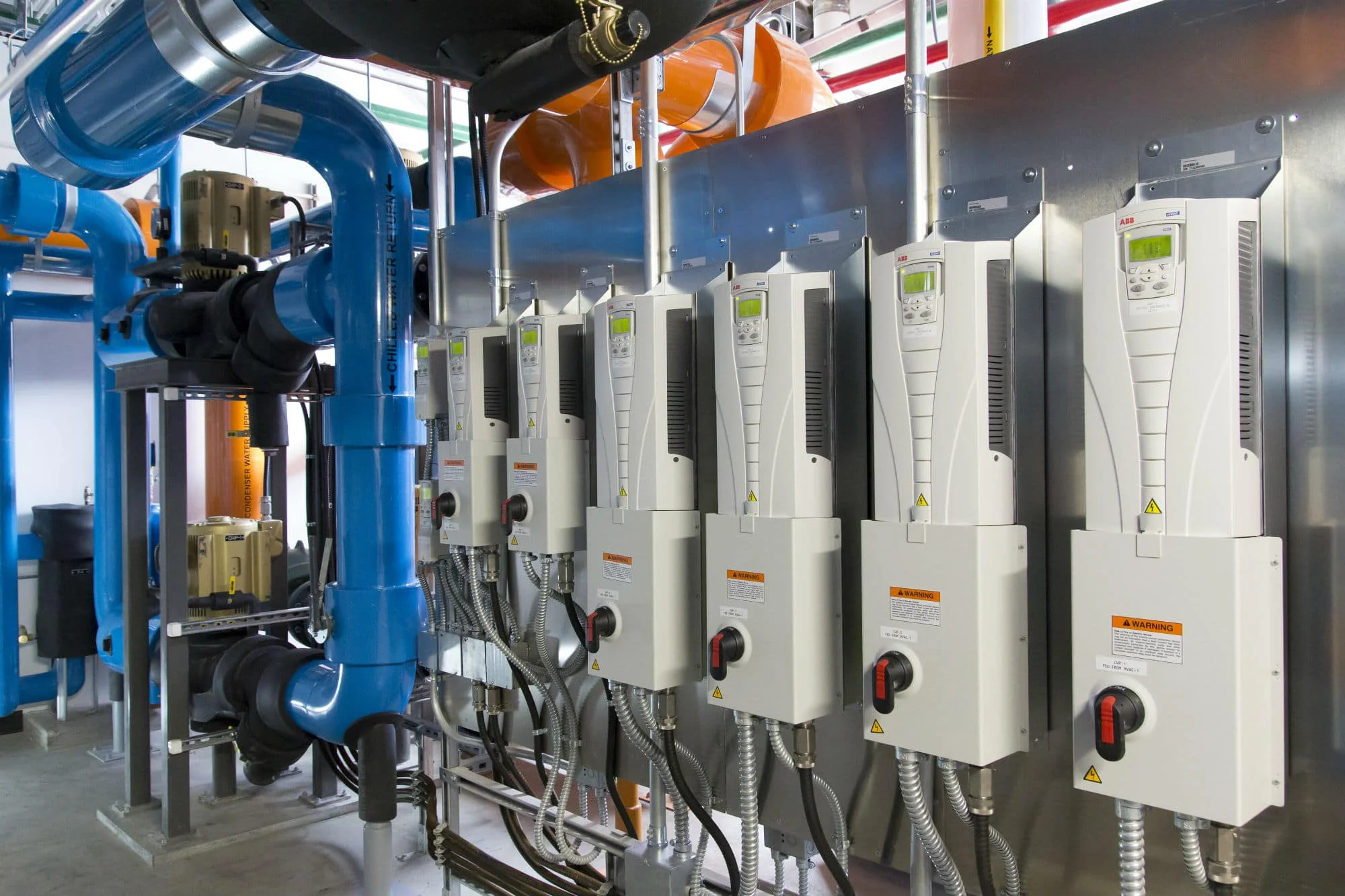
Understanding the critical difference between chiller-only IPLV and comprehensive NPLV for optimal facility energy performance in Southern California.
Direct Engineering Summary
True all-in central plant kW/ton is calculated by summing the power consumption of the chiller, primary chilled water pump, condenser water pump, and cooling tower fans, then dividing by the chiller's cooling load in tons. This metric often targets below 0.62 kW/ton for optimal efficiency, significantly differing from a chiller's nameplate Integrated Part Load Value (IPLV) which only considers the chiller itself. Western Mechanical, Inc., CSLB #618138, and our UA Local 250 journeymen specialize in achieving these efficiencies. Contact us at (661) 251-0111.
Engineering Tolerances & Governing Standards
Parameter
Specification
Standard
Target All-In Plant Efficiency (NPLV)
< 0.62 kW/ton
ASHRAE 90.1-2019 Appendix G
AHRI 550/590-2020 Part-Load Rating
Integrated Part Load Value (IPLV) or Non-Standard Part Load Value (NPLV)
AHRI 550/590-2020
Condenser Water Entering Temperature
85°F (29.4°C) for IPLV; Site-Specific for NPLV
AHRI 550/590-2020
Chilled Water Leaving Temperature
44°F (6.7°C)
AHRI 550/590-2020
Cooling Tower Fan Power Factor
> 0.90
IEEE 519-2014
The Deception of Chiller Nameplate IPLV Ratings
Chiller nameplate Integrated Part Load Value (IPLV) can be misleading for facility directors seeking true plant efficiency. IPLV, as defined by AHRI Standard 550/590, is a single-point, weighted average of chiller efficiency at various part-load conditions (100%, 75%, 50%, 25% capacity). Crucially, it only accounts for the chiller's power consumption and assumes a fixed condenser water entering temperature of 85°F (29.4°C). This narrow scope fails to capture the dynamic interplay of ancillary equipment or the warmer, often fluctuating, condenser water temperatures prevalent in Southern California's arid climate.
While IPLV offers a baseline for comparing chiller models, it does not reflect real-world operational costs. A chiller with an excellent IPLV might perform poorly in an actual plant if its associated pumps and cooling tower are inefficient or undersized. Furthermore, the 85°F condenser water assumption is often optimistic for many Southern California facilities, especially during peak summer loads, leading to higher actual kW/ton figures than advertised. Western Mechanical, Inc. focuses on comprehensive system evaluation to avoid these pitfalls.
Calculating True All-In Central Plant kW/Ton with NPLV
To derive a truly representative all-in central plant kW/ton, facility engineers must move beyond IPLV and calculate a Non-Standard Part Load Value (NPLV) that incorporates all major power consumers. This includes the chiller, the primary chilled water pump, the condenser water pump, and the cooling tower fans. Each component's actual power draw (kW) at various load points must be measured or accurately estimated. The sum of these individual kW values, divided by the chiller's cooling output in tons, yields the comprehensive plant kW/ton.
Achieving a total plant efficiency below 0.62 kW/ton is often the benchmark for high-performance facilities. This requires meticulous system design, precise controls integration, and regular commissioning. Factors like variable frequency drives (VFDs) on pumps and fans, optimized chilled water and condenser water setpoints, and proper cooling tower maintenance significantly impact this metric. Our UA Local 250 journeymen at Western Mechanical, Inc. leverage advanced instrumentation to precisely measure and optimize these parameters for maximum ROI.
Optimizing Ancillary Equipment for Peak Performance
The efficiency of primary and condenser pumps, along with cooling tower fans, is paramount to achieving an optimized all-in plant kW/ton. Oversized or constant-speed pumps can consume disproportionately more energy than necessary, especially at part-load conditions. Implementing VFDs on these components allows them to modulate flow and speed precisely to match the system's actual demand, dramatically reducing power consumption. Proper pump impeller trimming and selection based on actual system head loss are also critical considerations.
Cooling tower fan efficiency is another key area. Factors such as fan blade design, motor efficiency, and control strategies (e.g., modulating fan speed based on condenser water temperature reset) directly impact overall plant efficiency. Fouling of cooling tower fill or condenser tubes can also increase head pressure, forcing pumps and fans to work harder. Western Mechanical, Inc. provides comprehensive diagnostics and maintenance to ensure all ancillary equipment operates within design parameters, preventing efficiency degradation and extending asset lifespan.
UA Local 250 Certified Field Diagnostic & Commissioning Protocol
Verify chiller kW draw and tonnage output using calibrated power meters and flow meters, comparing to AHRI 550/590 data.
Measure instantaneous kW consumption of primary chilled water pumps and condenser water pumps, noting VFD output frequency.
Record cooling tower fan motor kW draw and fan speed (RPM) at various ambient conditions.
Calculate actual condenser water approach temperature and range, ensuring compliance with design specifications and identifying potential fouling.
Perform a comprehensive energy balance across the entire central plant to identify parasitic loads and validate total system kW/ton.
Facility Director & Chief Engineer FAQs
What is the primary difference between IPLV and NPLV?
IPLV (Integrated Part Load Value) is a chiller-only efficiency rating based on fixed AHRI conditions. NPLV (Non-Standard Part Load Value) is a more comprehensive, site-specific metric that includes the chiller, pumps, and cooling tower fans, reflecting actual operating conditions and ancillary equipment power consumption.
Why is 0.62 kW/ton considered a benchmark for central plant efficiency?
Achieving below 0.62 kW/ton signifies a highly efficient central plant, often meeting or exceeding ASHRAE 90.1 Appendix G performance targets. This benchmark indicates optimized chiller, pump, and cooling tower operation, leading to significant energy cost savings for the facility.
How do warmer Southern California condenser water temperatures affect plant efficiency?
Warmer condenser water temperatures, common in Southern California, force chillers to work harder, increasing their kW/ton. This highlights the importance of optimizing cooling tower performance and calculating NPLV using actual site conditions rather than generic IPLV assumptions.
Can Western Mechanical, Inc. help my facility reduce its plant kW/ton?
Absolutely. Western Mechanical, Inc. specializes in comprehensive central plant optimization. Our UA Local 250 journeymen utilize advanced diagnostics and engineering expertise to analyze your entire system, identify inefficiencies, and implement solutions to significantly reduce your all-in plant kW/ton.
Acton Headquarters & 24/7 Southern California Dispatch
Western Mechanical, Inc. • 2210 Soledad Canyon Road, Suite O, Acton, CA 93510 • Primary Phone: (661) 251-0111 • 24/7 Toll-Free: (800) 585-5085 • CSLB #618138 (C-20, C-38, C-4)