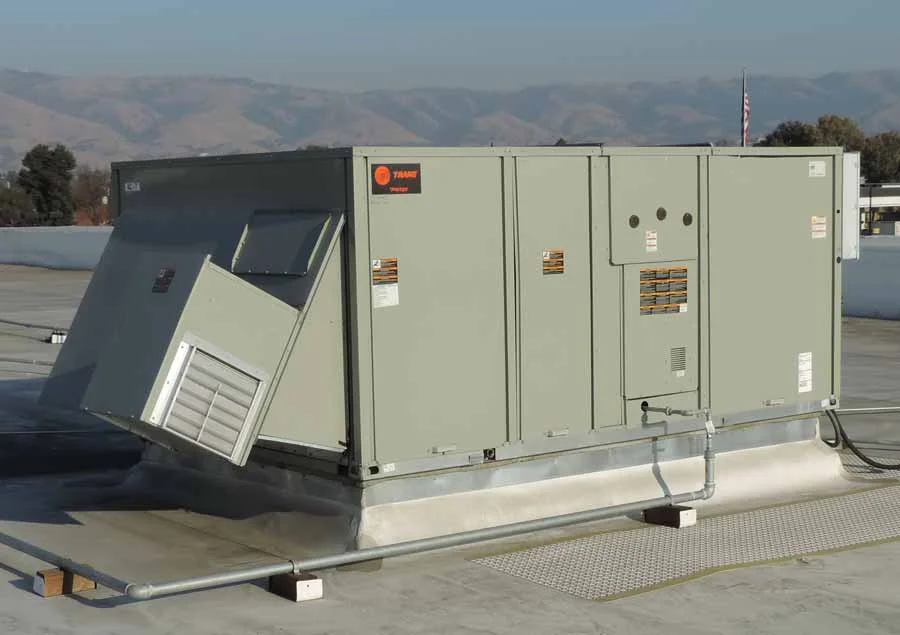
Essential facility director guide to factory/field refrigerant mitigation boards, ducted leak sensors, and UL 60335-2-40 compliance for new RTUs.
Direct Engineering Summary
The 2026 A2L commercial HVAC transition, primarily involving R-454B and R-32, necessitates strict adherence to UL 60335-2-40 for new RTUs, focusing on integrated refrigerant leak detection systems. These systems must energize supply blowers to dilute refrigerant concentrations below 25% of the Lower Flammability Limit (LFL) and prevent accumulation in occupied spaces or shafts. Western Mechanical, Inc., CSLB #618138, employs UA Local 250 journeymen to ensure compliant installations and retrofits, safeguarding facility operations. Contact us at (661) 251-0111 for expert guidance.
Engineering Tolerances & Governing Standards
Parameter
Specification
Standard
A2L Refrigerant LFL Threshold
>= 3.5 kg/m^3 (e.g., R-454B LFL: 0.29 kg/m^3)
ASHRAE 15-2022 / UL 60335-2-40
Leak Sensor Activation Level
<= 25% of LFL (Lower Flammability Limit)
UL 60335-2-40 Annex LL.1
Ventilation Rate (Mitigation)
Sufficient to reduce concentration below 25% LFL within 5 minutes
UL 60335-2-40 (LL.2.2.1)
Maximum Charge (R-454B, High Occupancy)
11.4 kg (25.1 lbs) for direct systems
ASHRAE 15-2022 Table 4.2.1.2
Minimum Airflow for Dilution
Calculated based on room volume and LFL
ASHRAE 15-2022 Section 8.11
Navigating A2L Refrigerant Safety Systems for Commercial RTUs
The impending 2026 transition to A2L mildly flammable refrigerants like R-454B and R-32 for commercial Rooftop Units (RTUs) introduces stringent safety requirements, particularly concerning refrigerant leak detection and mitigation. Facility directors must understand that new A2L-compliant RTUs will integrate advanced factory-installed leak sensors and associated control boards. These systems are designed to detect refrigerant concentrations well below their Lower Flammability Limit (LFL), typically activating at 25% of LFL, to prevent hazardous accumulation in occupied spaces or mechanical shafts.
Compliance with UL 60335-2-40 is paramount, dictating not only the sensitivity of these sensors but also the automatic response mechanisms. Upon detection, the mitigation board must immediately energize the RTU's supply blower, initiating a controlled dilution sequence. This proactive ventilation is critical in Southern California's often tightly sealed commercial buildings, ensuring that any leaked refrigerant is rapidly dispersed and exhausted, maintaining occupant safety and preventing potential ignition sources. Proper commissioning by UA Local 250 journeymen is essential to validate these integrated safety protocols.
Ducted Leak Sensors and Shaft Management Under UL 60335-2-40
A key differentiator for A2L RTU installations involves the strategic placement and functionality of ducted leak sensors, especially when refrigerant lines traverse vertical shafts or return plenums. UL 60335-2-40 mandates that any potential refrigerant accumulation points, including shafts, must be monitored. This often translates to installing dedicated refrigerant sensors within the supply or return air ducts, directly upstream or downstream of the RTU, and potentially within the shaft itself if the refrigerant piping runs through it.
The design intent is to prevent refrigerant stratification and ensure rapid detection. If a leak occurs within a shaft, the sensor must trigger the RTU's mitigation sequence, not only activating the supply fan but potentially also controlling exhaust fans to create negative pressure in the shaft, preventing refrigerant migration into occupied areas. Western Mechanical, Inc. specializes in designing and implementing these complex mitigation strategies, ensuring that all field-installed components integrate seamlessly with the factory controls and meet the prescriptive requirements of ASHRAE 15-2022 and Title 24 Part 6 for energy efficiency and safety.
Lifecycle ROI and Code Compliance for A2L Refrigerant Systems
Investing in A2L-compliant commercial RTUs, while initially appearing to have a higher upfront cost due to integrated safety features, offers significant lifecycle Return on Investment (ROI) through enhanced safety, reduced liability, and future-proofing against evolving environmental regulations. The proactive leak detection and mitigation systems minimize refrigerant loss, reducing operational expenses associated with refrigerant replacement and potential environmental fines. Furthermore, these systems contribute to a safer working environment, reducing risks for facility personnel and occupants.
Beyond immediate safety, adherence to ASHRAE 15-2022 and UL 60335-2-40 ensures long-term code compliance, avoiding costly retrofits or penalties down the line. Western Mechanical, Inc. provides comprehensive engineering and installation services, leveraging our UA Local 250 union workforce to ensure every A2L RTU installation is meticulously executed, commissioned, and documented. This meticulous approach guarantees optimal system performance, energy efficiency, and full regulatory compliance for Southern California's industrial and commercial facilities. Our CSLB #618138 ensures quality and accountability.
UA Local 250 Certified Field Diagnostic & Commissioning Protocol
Verify refrigerant leak sensor calibration using certified test gas at 25% LFL concentration.
Confirm proper wiring and functionality of the factory mitigation board, including alarm outputs to BMS/BAS.
Test supply blower activation and sustained operation upon simulated leak detection, measuring airflow rates.
Inspect ducted sensor placement for optimal detection in return air or shaft pathways, ensuring no airflow bypass.
Document all A2L refrigerant charge calculations, sensor locations, and mitigation sequence testing results for regulatory compliance.
Facility Director & Chief Engineer FAQs
What are the primary safety concerns with A2L refrigerants like R-454B in commercial RTUs?
A2L refrigerants are mildly flammable, requiring enhanced safety measures. The primary concern is preventing refrigerant accumulation in concentrations that could reach their Lower Flammability Limit (LFL). This necessitates sophisticated leak detection and mitigation systems to ensure occupant safety and prevent potential ignition.
How does UL 60335-2-40 impact new commercial RTU installations?
UL 60335-2-40 establishes specific safety requirements for A2L refrigerant equipment. For new commercial RTUs, it mandates integrated leak detection, automatic fan activation for dilution, and proper management of refrigerant within occupied spaces and building shafts to prevent hazardous concentrations.
What role do ducted leak sensors play in A2L refrigerant systems?
Ducted leak sensors are crucial for detecting refrigerant leaks within the air distribution system, particularly in return plenums or shafts where refrigerant might accumulate. Upon detection, these sensors trigger the RTU's mitigation protocols, such as energizing the supply blower, to dilute and disperse the refrigerant safely.
Will existing commercial RTUs need to be replaced for A2L compliance?
Generally, existing RTUs designed for A1 refrigerants cannot be simply retrofitted with A2L refrigerants due to fundamental differences in safety requirements, including leak detection and mitigation. New A2L-specific RTUs are typically required to meet the stringent UL 60335-2-40 and ASHRAE 15 standards for safe operation.
Acton Headquarters & 24/7 Southern California Dispatch
Western Mechanical, Inc. • 2210 Soledad Canyon Road, Suite O, Acton, CA 93510 • Primary Phone: (661) 251-0111 • 24/7 Toll-Free: (800) 585-5085 • CSLB #618138 (C-20, C-38, C-4)